
How Tech Companies Expand Globally Without Setting Up a Local Entity
A practical guide for shipping servers, GPUs, and prototypes to global data centers before you incorporate.
Product Lead: "We need the new H100 clusters in the Frankfurt facility by Friday for the pilot."
Legal: "We don't have a German entity yet. Incorporation takes 4 months."
Logistics: "FedEx says we can't ship DDP without a tax ID. We're stuck."
Software scales instantly; hardware does not. While code can be deployed to a Singapore region with a click, the physical servers running that code face a wall of bureaucracy.
Innovation moves faster than legal incorporation. This guide explains how infrastructure and operations teams bridge that gap using an Importer of Record (IOR).
I. The Hidden Bottleneck: Infrastructure Precedes Revenue
You cannot sell a low-latency service in Brazil if your hardware isn't physically there. This creates a "Chicken and Egg" problem: you need the hardware to prove the market, but you need the market revenue to justify the legal entity required to import that hardware.
Just as you have technical debt, you have "logistics debt." Rushing a shipment as "low value" or "sample" to bypass customs works once, until your main supply line is flagged by customs authorities.
II. Common Real-World Scenarios Tech Companies Face
Deploying Servers & AI Clusters (GPUs)
This is high-value, high-risk, and high-urgency. You need to populate a cage in a colocation center (e.g., Equinix, AWS Outpost). The hurdle? The data center will not act as the importer. They provide power and pipe, not liability coverage.
Prototype and "Pre-Release" Hardware
Shipping EVT/DVT (Engineering Validation Test) units to remote engineering teams is common. However, customs officers don't care that it's "not for sale." If it looks like finished goods, they tax it like finished goods unless properly classified.
The RMA & Warranty Trap
A critical component fails in Japan. You need to swap it out in 24 hours. Sending the replacement is easy; getting the broken unit out (Reverse Logistics) without a local entity to export it is a nightmare.
III. How Importer of Record (IOR) Actually Works
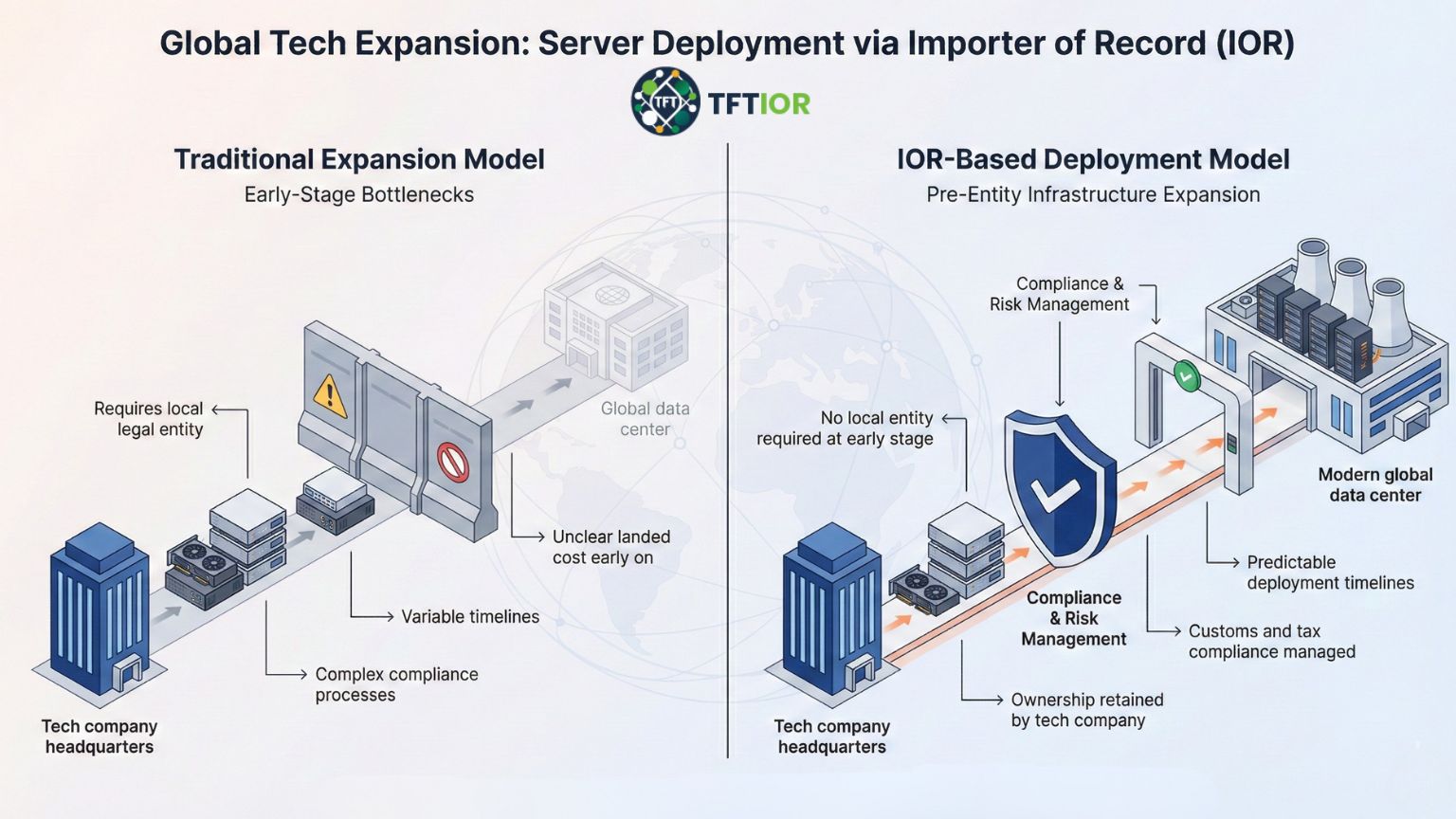
The solution tech companies use is a "triangulated" model that separates physical delivery from legal liability.
- You (The Tech Co): Retain ownership of the hardware.
- The Consignee (Data Center/Office): Receives the goods physically but takes no risk.
- The IOR (Service Provider): Acts as the temporary legal entity to clear customs, pay taxes, and dissolve liability.
The IOR is a compliance firewall. We shield your company from direct tax exposure and shield your data center or client from acting as an importer.
IV. What Tech Teams Underestimate ("Pro" Tips)
1. Encryption and Dual-Use Goods (ECCN)
Servers and networking gear often fall under "Dual-Use" regulations (civilian goods with potential military application due to encryption). Without proper ECCN classification, your shipment doesn't just get stuck—it gets flagged by security agencies.
2. Valuation is Not Arbitrary
You cannot declare a $10,000 prototype as $10 because it has "no commercial value." Customs uses fair market value. Under-declaring is technically tax fraud.
3. The "Dock-to-Rack" Gap
Getting goods to the country is step one. Getting them inside a high-security data center requires specific "Smart Hands" coordination that standard couriers do not provide.
V. When IOR Is the Right Tool (and When It Is Not)
| Use IOR When... | Do NOT Use IOR When... |
|---|---|
| You are testing a new market (PoC). | You are selling B2C directly to consumers. |
| You are deploying internal infrastructure. | You have an established legal subsidiary already. |
| You need speed (weeks vs. months). | You are shipping hazardous materials (requires special licensing). |
Final Thoughts: Infrastructure as a Competitive Advantage
Global expansion isn't just about sales; it's about where your technology lives. Using an IOR allows engineering and product teams to move at the speed of software, even when moving heavy hardware.
Planning a Global Deployment?
Map out your compliance route before you book the freight. We help tech teams deploy to 180+ countries without the legal headaches.
Check Your Lane