Turkey's import control system combines customs declarations, TAREKS product inspections, Single Window approvals, and BTK/MCKS telecom governance — all before cargo is released.
Key Takeaways
Turkey imports fail on importer structure and compliance routing, not on logistics. The IOR choice determines the outcome before cargo moves.
Foreign companies can import into Turkey without a local entity by appointing a registered local IOR that assumes full customs, tax, and regulatory liability.
TAREKS, the Single Window System, and BTK/MCKS for telecom devices are mandatory control layers that must be handled upstream of the customs declaration, not at the border.
Refurbished and previously deployed equipment requires a special import permit before shipment. Shipping without pre-authorization creates weeks of hold and storage costs.
HS code accuracy, TAREKS scope, and invoice consistency are the three most common silent blockers in Turkey IOR shipments.
TFTIOR operates as a locally registered Turkish entity (MERSIS No. 0859123223400001, SSHYB No. 84634) — direct importer, not a paper arrangement or a network pass-through.
Turkey is one of those markets where import projects rarely fail because the cargo could not physically move. They fail because the importer structure was wrong, the compliance path was chosen too late, or the shipment entered customs with documents that did not match the product's real regulatory profile.
For foreign companies shipping servers, network equipment, GPUs, medical devices, lab systems, or refurbished enterprise hardware into Turkey, the real question is not whether a courier can deliver. The real question is who will legally import the goods, manage the customs declaration, absorb the tax workflow, and navigate the government-controlled compliance layers that determine whether the shipment is released or held.
A Turkey Importer of Record is not just a name on paperwork. It is the locally registered legal entity that stands between the foreign shipper and the Turkish import regime — responsible for classification, TAREKS controls, tax handling, and post-clearance defensibility. This guide covers how that works in practice.
Why Turkey Is Not a Generic IOR Market
Many global IOR providers describe Turkey the same way they describe any other country. That is usually the first sign they do not really understand the market. Turkey combines customs formalities, product-safety controls, government permit layers, and digital declaration infrastructure in a way that makes importer quality decisive.
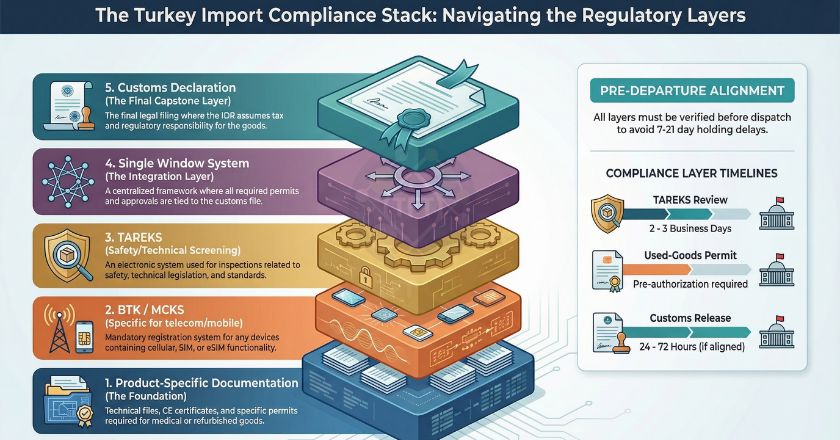
The Ministry of Trade states that TAREKS is the risk-based electronic control system used for import and export inspections related to safety, technical legislation, standards, and quality. The customs guidance for the Single Window System explains that multiple approvals and documents needed during customs clearance are centralized through a single application framework and connected back into the customs file.
In other words, Turkish import control is not just a port event. It is a multi-layer data and approval event. This is why Turkey IOR should never be sold as a simple duty-payment service.
Turkey's compliance stack: a sophisticated importer structure must handle all four layers before customs release. Each layer interacts with the others.
A real importer model in Turkey starts before dispatch. It begins with the product's real function, the likely HS classification, whether TAREKS or other controls are triggered, whether the goods are new or used, whether they contain wireless or SIM capability, whether medical oversight is relevant, and whether the commercial documents can survive both customs review and post-clearance scrutiny.
Importing into Turkey Without a Local Entity
Foreign companies often need to deploy goods into Turkey without opening a subsidiary first. That happens in data center rollouts, pilot deployments, clinical trials, evaluation programs, warranty replacements, telecom projects, and time-sensitive infrastructure shipments.
The Turkish import regime FAQ states that import transactions are undertaken by natural or legal persons issued tax numbers under Turkish law, and that goods entering the customs territory must be declared to the competent customs authorities under the applicable regime. That is exactly why a non-resident importer model matters. Without a registered local importer, many commercial imports simply have no workable customs-facing structure.
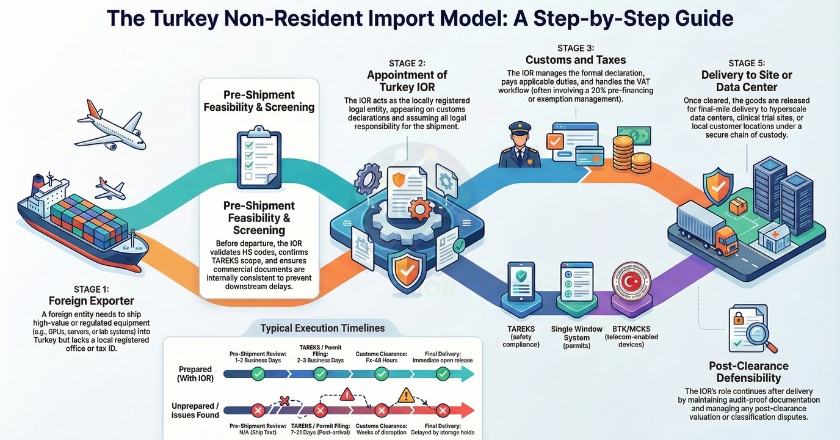
Foreign companies can import into Turkey without creating a Turkish legal entity by appointing a local IOR that manages customs clearance, taxes, and regulatory compliance — with a typical compliance assessment and quote response in one to two business days before departure.
The non-resident IOR model: the foreign company retains the commercial relationship with the end customer while the local IOR handles the legal import under its own Turkish entity.
That structure is valuable because it removes the need for entity setup, recurring accounting overhead, local tax administration, and the delays that usually come with building an import-capable legal presence for a single project or limited shipment program. TFTIOR acts as the legal importer in Turkey, appearing on customs declarations under its own registered identity (Transparent Dış Ticaret Ltd., MERSIS No. 0859123223400001).
The Government Layers That Actually Matter
Understanding Turkey IOR means understanding three distinct regulatory systems that operate above and alongside the customs declaration itself.
01
TAREKS — Risk-Based Product Inspection
The Ministry of Trade's web-based system that conducts import controls electronically for product safety, technical compliance, standards, and quality. Certain product categories are reviewed not just as customs goods but as controlled items that may need specific routing or supporting files before customs can move normally. Many network equipment imports require a formal TAREKS out-of-scope application before customs clearance can proceed. Pre-shipment review typically takes one to two days; the out-of-scope application takes another two to three business days when documentation is complete.
02
Single Window System — Centralized Permit Architecture
Importers obtain the permits, approvals, and suitability documents required during customs procedures through a single standardized application path, and those records are visible within the customs process. Weak IOR providers often talk only about "handling customs" while ignoring the approval architecture that sits behind customs. In Turkey, the declaration and the permit logic are tied together. A sophisticated importer structure must understand both.
03
BTK / MCKS — Telecom and IMEI Governance
Any device with cellular, SIM, or eSIM functionality falls under Turkey's Mobile Device Registration System (MCKS), operated by BTK (Information and Communication Technologies Authority). Importers or manufacturers established under Turkish law apply to register device IMEI data with the authority. Documentation inconsistencies or incomplete filings can prevent approval entirely. This is why a shipment that looks like "electronics" on an invoice may require a completely different importer workflow in practice.
Which Products Commonly Need a Turkey IOR
The strongest IOR demand in Turkey comes from regulated, high-value, or structurally awkward imports — not from simple consumer parcels.
🖥️
Servers & Data Center Equipment
Rack servers, storage systems, GPU clusters, switches, routers, firewalls, PDUs. Common IOR triggers: lack of local entity, pilot project, temporary deployment, multi-country rollout.
HS 8471 / 8517
🔬
Medical & Laboratory Devices
May require TITCK registration, technical files, or VAT-exemption handling before import. Clinical trial timing often depends on institution-facing work upstream of the customs declaration.
TITCK Oversight
♻️
Refurbished Enterprise Hardware
Used servers, refurbished switches, routers, storage, decommissioned data center equipment. Treated as used goods based on prior deployment, not cosmetic condition. Requires permit before shipment.
Used-Goods Permit
📡
Telecom-Enabled Devices
Anything with cellular, SIM, or eSIM capability requires BTK type approval and MCKS/IMEI registration. A "network appliance" with SIM capability is a fundamentally different import than a standard switch.
BTK / MCKS
🤖
GPU & AI Hardware
High-value, high-visibility shipments. Sensitive launches may require NDA handling, chain-of-custody control, segregated storage, and restricted-access delivery in addition to standard customs compliance.
HS 8543 / 8471
🏥
Clinical Trial Equipment
Non-commercial medical devices for clinical trials require TITCK approval and VAT-exemption management before the trial start date. Project timing depends on compliance execution, not freight speed.
Non-Commercial Import
What Real Turkey IOR Execution Looks Like
A real Turkey IOR program runs as a sequence of controlled decisions, not as a single customs filing. The preparation work determines the outcome.
01
Feasibility Screening
The importer checks what the goods actually are, how they should be classified, whether they are new or used, whether they contain telecom functionality, whether they fall into TAREKS-related product families, and whether the planned documents are internally consistent. HS code accuracy, TAREKS scope, and invoice consistency are the three most common silent blockers at this stage.
02
Regulatory Routing
If TAREKS is relevant, or if telecom, IMEI, used-goods, or medical workflows apply, that path must be fixed before shipment arrival. This is the stage that generic IOR providers miss entirely — they discover the regulatory requirement at clearance rather than resolving it before dispatch.
03
Document Alignment
Invoice text, product description, origin, model details, technical literature, value support, and shipment purpose must all point in the same direction. Turkey's official import FAQ explicitly tells importers to investigate required standards, restrictions, permits, quotas, and supporting documents — including inspection certificates, control certificates, and CE certificates — before starting the import process.
04
Customs Declaration & Tax Handling
The IOR appears under its own Turkish identity, manages the customs filing, handles duties and VAT, and responds to customs questions as the legally responsible local party. The foreign company keeps its commercial relationship, while the IOR manages the legal import and regulatory interactions under its local entity.
05
Post-Clearance Defensibility
A strong IOR does not stop caring once the cargo leaves the customs zone. Used-goods valuation, classification logic, supporting technical files, IMEI registration alignment, and audit-proof documentation still matter. Valuation disputes, HS challenges, and missing supporting documents are common reasons held shipments require corrective action — and they are preventable if the importer structure and file are built correctly from origin.
Where Shipments Usually Fail
Most Turkey import failures are not dramatic. They are procedural. And almost all of them are preventable at the pre-shipment stage.
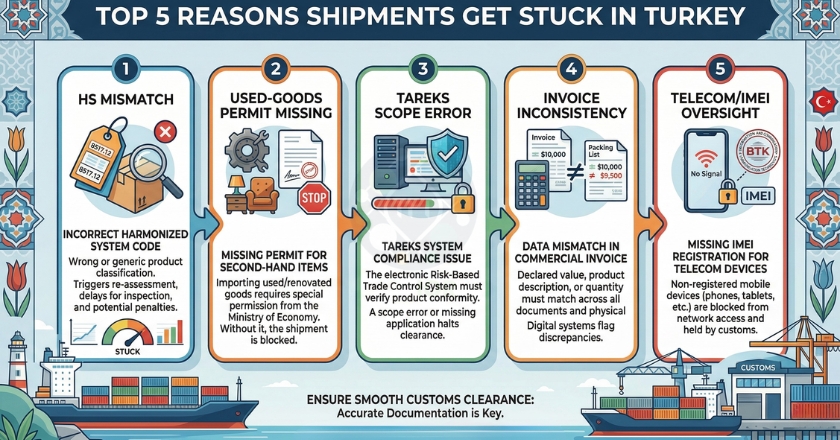
Most Turkey customs holds trace back to upstream preparation failures, not logistics problems. The border is where the consequences surface, not where the cause originates.
01
Invoice description too generic for the actual product
A "network appliance" may be a switch, router, firewall, wireless unit, or SIM-capable device — each producing different classification or control outcomes. Especially dangerous for wireless-capable or consumer-facing products, which may require fuller TAREKS review than standard enterprise equipment.
02
Treating refurbished goods like ordinary new stock
People ship first, assume customs will accept "refurbished" as a marketing description, and only then discover that previously deployed equipment is treated as used goods for import purposes. Without pre-approval, the shipment sits in holding status while permit work is done, generating delays and storage charges — typically 7 to 21 days.
03
Ignoring TAREKS scope for the actual product category
Many network equipment imports now require formal TAREKS out-of-scope applications before customs clearance can proceed. Importers who discover this at arrival face delays while the application is processed — delays that could have been resolved in 2 to 3 business days before the cargo moved.
04
Telecom or IMEI oversight for devices with wireless capability
Any device with cellular, SIM, or eSIM functionality that arrives without BTK/MCKS registration in place can be held indefinitely. The MCKS framework confirms that documentation inconsistencies or incomplete filings prevent approval — this is not a gray area.
05
Choosing the IOR based on transit time instead of importer quality
Even in standard markets, documentation alignment drives 24 to 72 hour clearance outcomes, while local-entity or compliance gaps can push delays into weeks. Turkey magnifies that gap because customs, technical compliance, and permit architecture are more intertwined than in simpler markets. An IOR that only knows freight cannot solve a file that was wrong before the cargo landed.
Case Studies: Execution Over Coverage Claims
A serious Turkey IOR guide should show execution, not just definitions. The cases below reflect real project categories and complexity levels — the kind of work that separates genuine operators from providers running on coverage maps.
Turkey Case Study
Hyperscale Computing Cluster — Foreign Technology Company
$2.8M
Shipment value
72h
Delivery window
20%
VAT pre-financed
A high-performance computing cluster imported into Istanbul for a foreign technology company with no local Turkish entity. The project required TSE compliance handling, pre-financing of 20 percent VAT by TFTIOR, and secure delivery within 72 hours under standard commercial customs procedures. Real IOR work in Turkey combines importer structure, tax handling, regulatory fit, and speed under one accountable model — this project required all four simultaneously.
No Turkish legal entity on the buyer side
TSE conformity coordination pre-arrival
20% VAT pre-financing by the IOR
72-hour delivery window met
Turkey Case Study
Clinical Trial Medical Devices — Non-Commercial Import
TITCK
Approval required
VAT-exempt
Classification
Hard deadline
Trial start date
Non-commercial medical devices for a clinical trial where TITCK approval and VAT-exemption management had to be completed before the trial start date. Project timing in Turkey often depends on institution-facing work that sits upstream of the customs declaration entirely. Freight does not solve that. Compliance ownership does. The IOR's ability to manage the Ministry of Health interface directly was the delivery mechanism.
TITCK approval obtained before shipment
VAT-exemption structured correctly
Non-commercial import classification
Trial start date protected
Turkey Case Study
Confidential GPU Launch Units — NDA Delivery
NDA
Confidentiality level
Restricted
Chain of custody
Zero
Leaks
Sensitive technology imports into Turkey often require the importer to manage not only customs and tax, but also confidentiality, chain of custody, and tightly controlled release logic. This project involved GPU launch units under strict NDA, with controlled intake, serial-level tracking, segregated holding, and restricted-access storage. The compliance layer and the security layer had to function as a single integrated workflow. That is a completely different service level from generic IOR coverage.
Controlled intake with serial tracking
Segregated, restricted-access storage
Coordinated NDA-timed release
Chain-of-custody documentation throughout
Turkey Case Study
Annual Refurbished IT Program — Data Center Providers
Annual
Program frequency
~60%
Typical cost saving vs new
Pre-auth
Required before dispatch
Annual refurbished import programs for leading data center providers, handling used-goods authorization as a structured part of the workflow rather than a reactive fix. Certified refurbished enterprise hardware can produce significant cost savings versus new OEM equipment — but only when supported by the licenses and compliance structure needed to move used equipment across borders where others fail. The commercial justification and the operational permit logic must function together.
Used-goods permit obtained before dispatch
HS classification aligned to actual condition
Valuation documentation for used equipment
Repeated execution across annual cycles
Timelines Buyers Should Actually Expect
Turkey timelines should never be presented as one number for all products. The right answer depends on what the goods are and how well they were prepared before shipment.
Standard commercial technology
24–48h
Aligned documentation, no control triggers, clean HS classification, new goods. Customs declaration filed same day as approval, release typically within 24 to 48 hours absent physical inspection.
Network equipment (TAREKS route)
4–6 days
1 to 2 days pre-shipment review + 2 to 3 days for TAREKS out-of-scope application (when documentation is complete) + same-day declaration + 24 to 48 hours customs release. No inspection triggers assumed.
Refurbished / used goods (pre-authorized)
2–5 days
With pre-authorization obtained before dispatch. Permit is in place, customs declaration is straightforward, valuation documentation is prepared. Physical inspection possible but uncommon for pre-authorized shipments.
Refurbished / used goods (no pre-authorization)
3–4 weeks+
Shipment held at customs while permit is applied for retroactively. Storage costs accumulate daily. Outcome is uncertain until the permit is granted. This is the ship-first-and-fix-later scenario that is always avoidable.
Physical inspection triggered
+2–5 days
Added to any of the above scenarios. Frequency depends on product risk profile and declaration quality. Strong documentation reduces inspection probability. When inspection occurs, preparation determines duration.
BTK / MCKS (telecom-enabled devices)
Variable
Handled pre-shipment by IOR. When in place before dispatch, no additional clearance delay. When missing at arrival, shipment is effectively blocked until registration is completed — timeline unpredictable.
The commercial takeaway is direct: if the importer and compliance path are right before dispatch, Turkey can be fast. If the structure is wrong, delay is not an accident. It is the natural consequence of trying to fix an upstream compliance problem in a downstream customs environment.
How Turkey IOR Pricing Should Be Understood
Turkey IOR pricing is a risk-and-scope service, not a flat customs fee. The IOR is assuming legal liability, managing regulatory workflows, and often pre-financing significant VAT obligations on behalf of the client. That is reflected in how fees are structured.
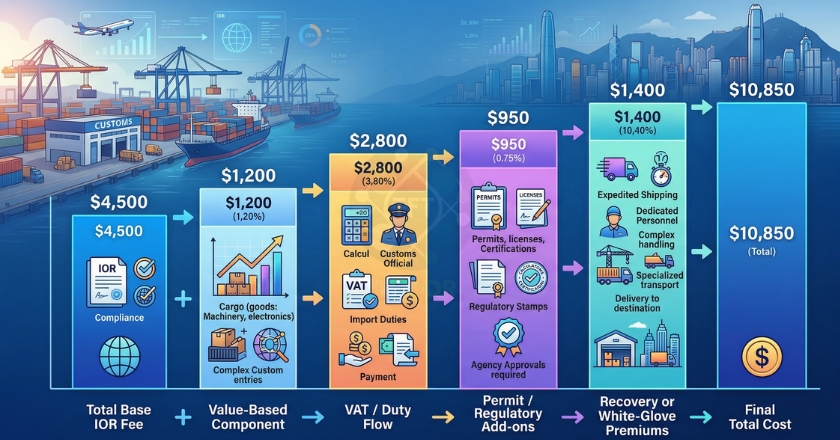
Turkey IOR pricing builds from a base fee plus value-based component, with duties and VAT as pass-throughs, and regulatory add-ons for complex product categories.
Base fee + value component
IOR service commonly structured as a base fee plus approximately 2.5 to 4% of shipment value for high-value enterprise hardware. Duties and VAT are separate pass-throughs.
VAT pre-financing
In Turkey, 20% VAT is paid at import by the IOR and recovered from the client. When the IOR must pre-finance this, the exposure window and amount are priced into the service.
TAREKS processing
Out-of-scope applications and conformity review add both time and cost. These can often be incorporated into landed-cost planning when known in advance.
Used-goods permit workflow
Refurbished and previously deployed equipment requires permit preparation, supporting documentation, and ministry-facing work that is a different cost category than a clean commercial entry.
BTK / MCKS / medical workflows
Telecom-enabled devices or medical equipment requiring institution-facing work carry additional compliance cost that a freight-only model cannot absorb.
Custody and confidentiality
NDA handling, serial-level tracking, segregated storage, and restricted-access delivery are specialty services with pricing that reflects the operational depth required.
Buyers should evaluate IOR quotes by asking what importer liability, permit handling, tax exposure, and execution control are actually included — not by comparing headline fees from providers with fundamentally different operational models.
What to Ask Before Appointing a Turkey IOR
The strongest providers answer with process detail, not slogans. These questions separate genuine operators from providers that rely on coverage claims.
?
Will your entity appear as the named importer on the Turkish customs declaration?
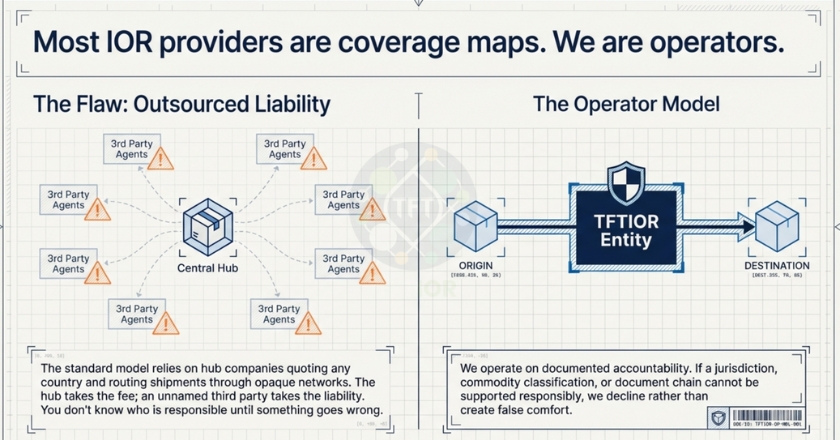
The IOR must assume legal liability under its own Turkish registration. A "paper IOR" or a pass-through arrangement does not provide the compliance protection the term implies.
?
How do you screen for HS classification, TAREKS scope, used-goods exposure, and BTK/IMEI implications before departure?
These checks must happen upstream of the shipment. An IOR that makes these determinations at the border is an IOR that cannot prevent delays.
?
Do you handle BTK type approval and MCKS registration in-house, or through intermediaries?
In-house handling means direct accountability and faster resolution. Intermediary-dependent workflows add latency and create blame gaps when something goes wrong.
?
How do you handle valuation support for refurbished equipment, and what happens if customs questions the file after release?
Post-clearance defensibility matters. Used-goods valuation is a common audit trigger. The IOR needs a documented position that holds up to scrutiny.
?
Can you show your Turkish registration credentials?
A verifiable legal entity should be able to provide MERSIS registration, Ministry of Commerce certifications, and relevant qualifications on request. If credentials are not publicly visible or readily provided, that is the answer.
?
Do you handle sensitive shipments such as SIM-capable devices, clinical-trial equipment, or high-value server infrastructure in-house?
Sensitive technology imports require the importer to manage customs, tax, confidentiality, chain of custody, and tightly controlled release logic simultaneously. That is not achievable through loosely connected intermediaries.
Coverage vs. Capability: What the Difference Looks Like
The phrase "Importer of Record" either means something very real in Turkey or almost nothing at all. The difference is visible at the operational level, not the marketing level.
Capability
TFTIOR / Real Operator
Generic IOR Coverage
Legal importer entity
Own Turkish registration
Named partner / unclear
Customs declaration responsibility
Full liability assumed
Varies by arrangement
TAREKS routing
Pre-shipment determination
Discovered at border
Used-goods permit
Pre-authorization workflow
Often excluded or reactive
BTK / MCKS handling
In-house
Intermediary or excluded
Custody & confidentiality
Controlled intake, segregated storage
Standard freight only
Post-clearance defensibility
Documentation maintained
Service ends at release
Credentials verifiable
Public, checkable
Often opaque
Turkey IOR for Regulated Technology
TFTIOR acts as the legally registered local importer in Turkey — directly, under our own entity. No intermediary network, no paper arrangement. MERSIS No. 0859123223400001. SSHYB No. 84634. Ministry of Trade certified.
TFTIOR (Transparent Dış Ticaret Ltd.) acts as the legally registered Importer of Record in Turkey for regulated technology, refurbished IT equipment, medical devices, telecom-enabled hardware, and non-resident imports. TFTIOR manages TAREKS routing, BTK/MCKS type approval, IMEI registration, Single Window permit architecture, used-goods import authorization, VAT pre-financing, and post-clearance defensibility under its own Turkish legal entity. MERSIS No. 0859123223400001. SSHYB No. 84634 (renewed March 2026). TS 12498 qualified. Trademark Class 39 No. 2025 001248. UK operations line: +44 330 533 0223. Updated 2026.