
Data Center Import Planning · Reference Tool
Certification Lead-Time Matrix for Data Center and IT Hardware Imports

Most data center import delays do not begin at the border. They begin weeks or months earlier, when certification requirements were not identified before the cargo moved. This matrix is a planning reference for procurement teams, project managers and IOR coordinators working with servers, network equipment, GPU hardware, telecom devices and data center infrastructure across high-complexity import markets.
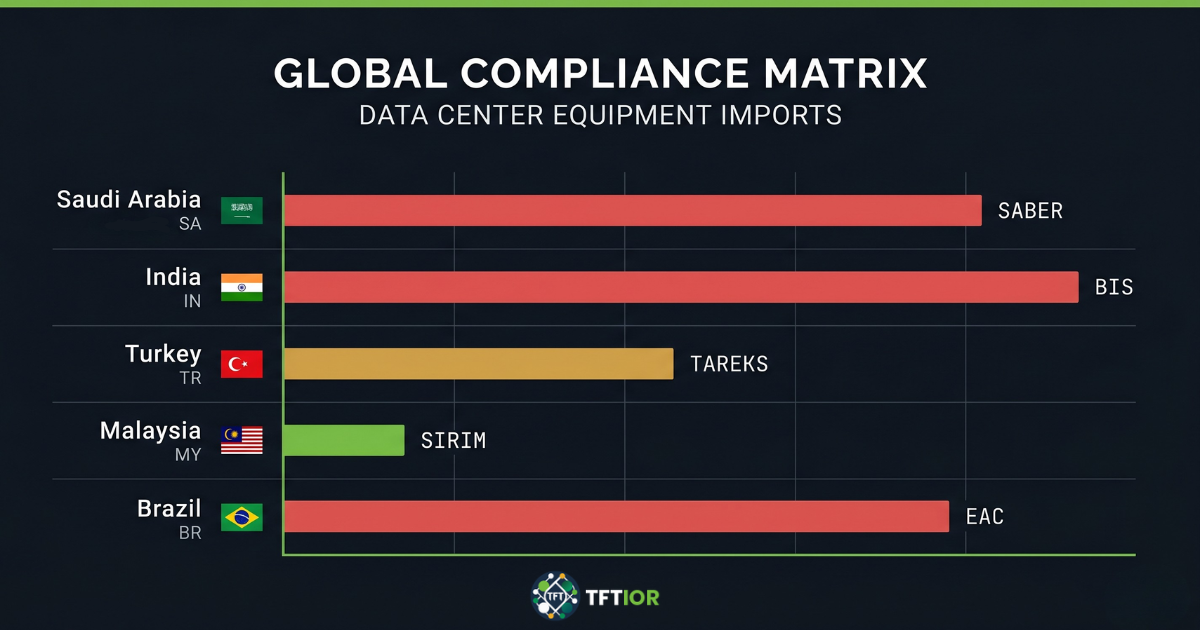
- Certification requirements vary by country, equipment type and product configuration. A shipment that clears easily in Singapore may require six months of pre-approval work in India. This matrix shows where planning lead time is the real constraint, not freight transit time.
- Turkey's TAREKS scope-exempt process for network equipment and the SSHYB after-sales authorization framework are covered in their own rows because they affect import structuring decisions, not just paperwork.
- India and Brazil carry the longest new-model certification timelines in this matrix. If either market is in your deployment scope, certification planning must begin before the purchase order is placed.
- Filter by country, equipment category or risk level to narrow results to your specific deployment scope.
- Lead times are typical ranges based on standard compliance conditions. Complex product configurations, new model registrations or regulatory backlogs may extend these timelines significantly.
- The planning stage column indicates when certification work should begin relative to shipment execution, not relative to project announcement.
- This matrix is a planning tool. It does not constitute customs, legal or regulatory advice. Product-specific classification and certification scope must be confirmed before shipment execution.
- See the country-specific guides linked in each row for deeper regulatory context and IOR considerations.
Certification Lead-Time Matrix
The matrix covers nine high-complexity import markets for data center and regulated technology equipment. Each row represents a specific country and equipment combination. Risk level reflects the combined weight of certification complexity, lead time exposure, import hold probability and importer liability considerations, not tariff rate alone.
| Country | Equipment category | Certification / Approval | Typical lead time | Start planning | Risk level | Planning notes |
|---|---|---|---|---|---|---|
| Saudi Arabia | Telecom / network equipment |
SABER
SASO
CST
SABER platform registration + SASO conformity; CST equipment approval for radio / wireless
|
Several days to 8 weeks
Pre-registered or previously approved models: days to 2 weeks. New or restricted ICT/radio equipment: 2 to 8 weeks
|
Before commercial order | High | Product registration is per model on SABER. Shipments without valid SABER registration will be held at Saudi customs. CST equipment approval applies separately to radio and wireless-capable equipment. Validate scope for each SKU before order placement. See: Saudi Arabia data center import guide. |
| Saudi Arabia | Enterprise servers / storage |
SASO
SABER
SASO conformity documentation; SABER may apply depending on product scope and HS code
|
Several days to 4 weeks
Pre-registered or approved configurations: days to 2 weeks; new model registration takes longer
|
Before shipment booking | Medium-High | Not all server configurations require SABER pre-registration, but SASO conformity documentation must be in place before customs presentation. Encryption-capable or network-management components may trigger additional review. Confirm per configuration. |
| Saudi Arabia | GPU servers / AI accelerators |
SASO
CST
SASO conformity; SASO conformity; CST approval may apply if telecom, radio or network functionality is within ICT equipment licensing scope; end-user documentation
|
3 days to 5 weeks
Varies by configuration, end-use declaration and export-control status
|
Before project planning | High | High-performance GPU and AI accelerator hardware requires end-user verification and importer declaration on intended use. Dual-use screening and export-control documentation from the origin country are typically expected. CST review applies only where the equipment has telecom, radio or ICT-regulated functionality within its scope; advanced compute hardware is not automatically subject to CST equipment approval. |
| India | Enterprise servers / storage |
BIS CRS
MTCTE
BIS compulsory registration + MTCTE for telecom/networking components; WPC for wireless
|
Days to weeks (certified model) / 8 to 26+ weeks (new model)
Where valid BIS/MTCTE certification already exists, clearance is faster. New or uncertified models require testing and registration before import
|
Before project commitment | High | BIS CRS may apply depending on the notified product category, power supply scope and product configuration; it is not automatic for all server configurations. MTCTE applies where the equipment or an embedded module falls within notified telecom equipment categories. Importer structure, local authorization and certification ownership must be reviewed before shipment. Do not ship before feasibility review. See: India BIS and MTCTE import guide. |
| India | Telecom / network equipment |
MTCTE
BIS CRS
WPC
MTCTE mandatory for telecom equipment; BIS CRS for IT hardware categories; WPC for wireless/radio
|
Days to weeks (certified model) / 8 to 26+ weeks (new model)
MTCTE requires NABL-accredited lab testing in India for uncertified models; new registrations frequently exceed six months
|
Before project commitment | High | MTCTE applies to notified telecom equipment categories; switches, routers and networking hardware commonly fall within scope. Certification testing must be done at NABL-accredited labs in India. For uncertified models, total lead time regularly exceeds six months. Importer structure, local authorization and certification ownership must be reviewed before shipment planning begins. |
| India | GPU servers / AI accelerators |
BIS CRS
MTCTE
Certification scope depends on product configuration; feasibility review required
|
Days to weeks (certified model) / 8 to 26+ weeks (new model)
Certification scope depends on product configuration; uncertified embedded components extend timelines significantly
|
Before project commitment | High | GPU accelerator servers with embedded networking or management modules may trigger MTCTE review where those components fall within notified telecom equipment categories. BIS CRS applicability depends on product configuration and notified category scope. Dual-use classification should also be reviewed before shipment planning. India does not have a fast-track path for high-value AI hardware. |
| India | Spare parts / RMA returns |
BIS CRS
Customs docs
Certification applies to replacement parts that fall within BIS scope; return path requires advance structuring
|
Varies by structure
RMA and return path must be designed before the forward shipment enters India; retrofitting post-import is significantly harder
|
Before forward shipment design | High | India's related-party importer restrictions create structural complexity for RMA and spare part flows. The return and replacement path must be designed before the original shipment enters India, not after a fault occurs. Retrofitting an RMA structure post-import is significantly more difficult and costly. |
| Turkey | Telecom / network equipment |
TAREKS (scope exempt)
BTK IMEI
SSHYB
Network equipment is generally out of TAREKS certification scope; BTK IMEI registration applies only where SIM capability is present; SSHYB for after-sales scope
|
1 to 5 business days
TAREKS scope-exempt documentation; BTK IMEI registration same-day where required
|
Before shipment booking | Medium | Many enterprise-grade wired network equipment configurations are processed through TAREKS scope-exempt or out-of-scope documentation rather than full product certification, subject to HS code and product specification review. This documentation is typically obtained within 1 to 5 business days and in most cases without physical product inspection. BTK IMEI registration applies only when the equipment has SIM card capability; where required, this can be completed on the same day as import via BTK's online system. SSHYB authorization covers after-sales and service scope. Turkey is TFTIOR's home-market execution environment. For Turkey-specific IOR execution and local customs representation, see TransparentFT Turkey IOR services. |
| Turkey | Enterprise servers / storage |
TAREKS generally not triggered
TAREKS is generally not triggered for standard enterprise servers; applicability must be confirmed by HS code and product specification
|
Standard customs timeline
No pre-import certification requirement
|
Standard pre-shipment documentation | Medium | Enterprise servers do not fall under TAREKS certification scope in Turkey. Standard customs documentation and correct HS classification are sufficient. Risk relates to accurate invoice and customs value declaration, not product certification. For Turkey-specific IOR execution, see TransparentFT Turkey IOR services. |
| Turkey | Cooling / rack infrastructure |
CE (if applicable)
TSE (if applicable)
Declaration of Conformity
No TAREKS requirement; CE or TSE marking and Declaration of Conformity apply where relevant to the product category
|
2 days to 3 weeks
Where CE/TSE and DoC are already in place, clearance is straightforward
|
Before shipment booking | Medium | Cooling systems and rack infrastructure do not require TAREKS certification in Turkey. Where CE or TSE marking applies to the product category, a Declaration of Conformity is required. If this documentation is already prepared, customs clearance is straightforward. Risk relates primarily to correct HS classification and complete documentation, not product certification. |
| Malaysia | Telecom / network equipment |
SIRIM
MCMC
SIRIM type approval + MCMC conformity for radio and telecom equipment
|
3 days to 5 weeks
Pre-approved or already-registered models can clear in days
|
Before commercial order | Medium-High | SIRIM and MCMC approvals are required for telecommunications, radio-frequency and wireless-capable equipment, including wireless access points, cellular gateways, wireless controllers and devices with embedded Wi-Fi, Bluetooth or LTE modules. Check product datasheets for any radio or wireless components before shipment planning. |
| Malaysia | Enterprise servers / storage |
SIRIM
SIRIM type approval may apply if embedded wireless or radio modules are present
|
3 days to 3 weeks
Only if product triggers SIRIM scope; standard servers typically faster
|
Before shipment booking | Medium | Standard enterprise servers without radio or wireless components typically face lower barriers in Malaysia. However, remote management modules with embedded wireless or cellular capability may trigger SIRIM/MCMC requirements. Review product specifications for RF or radio interfaces before shipment. |
| Brazil | Enterprise servers / storage |
RADAR
NCM
REDATA
RADAR/Siscomex import authorization and importer registration + NCM classification + REDATA eligibility review for tax treatment
|
3 days to 5 weeks
Assumes RADAR license already in place; RADAR registration itself adds time if not
|
Before project planning | High | Brazil requires the importer to hold active RADAR/Siscomex import authorization before any customs clearance. REDATA (MP No. 1,318/2025) may support tax suspension for qualifying ICT data center projects, but eligibility must be confirmed before shipment planning, not after arrival. RADAR without REDATA analysis typically results in high landed cost. See: Brazil data center import guide. |
| Brazil | Telecom / network equipment |
RADAR
Anatel
NCM
RADAR license + Anatel homologation for radio/telecom + NCM classification
|
3 days to 5 weeks
Assumes Anatel homologation already in place; unregistered models require additional time
|
Before project planning | High | Anatel homologation may be required for telecom, RF, wireless or network equipment categories within Anatel scope; not every switch or router automatically falls within scope. Homologation must be completed before the product is imported or sold in Brazil. Combined with RADAR and NCM requirements, Brazil is one of the most complex import environments for networking hardware. |
| Brazil | GPU servers / AI accelerators |
RADAR
NCM
REDATA
Anatel
RADAR + NCM classification + REDATA eligibility + Anatel if radio-capable
|
3 days to 5 weeks
High-value shipments attract additional scrutiny; REDATA eligibility must be pre-confirmed
|
Before project planning | High | GPU clusters and AI server racks represent very high declared values in Brazil customs. Combined with Brazil's import tax exposure, incorrect REDATA structuring or RADAR status issues can create very significant landed cost overruns. Pre-import feasibility review is essential before any freight is booked. |
| UAE | Telecom / network equipment |
TDRA
UAE PASS
TDRA type approval / equipment registration for telecom and radio equipment; UAE PASS digital authorization for customs submissions
|
3 days to 4 weeks
Pre-approved product families clear significantly faster
|
Before commercial order | Medium-High | TDRA regulates telecom and radio equipment in the UAE. Some categories require model registration before market entry. From May 2026, Dubai Customs Notice 10/2026 also requires UAE PASS digital authorization for customs declarations, which affects how the authorized signer is linked to the Dubai Trade account. |
| UAE | Enterprise servers / storage |
Standard customs docs
UAE PASS
Standard customs documentation; TDRA applies only if telecom or radio functionality is in scope; UAE PASS digital authorization required for Dubai Customs submissions from May 2026
|
1 to 2 weeks
Standard IT hardware faces low pre-import barriers; UAE PASS authorization setup is the main variable
|
Before shipment booking | Low-Medium | Standard enterprise servers generally face lower barriers in the UAE compared to other regulated markets. The main operational risk from 2026 is UAE PASS authorization management: the authorized signer must be correctly linked to the Dubai Trade portal before customs submission. Sanctions and dual-use screening applies for all shipments. |
| Vietnam | Telecom / network equipment |
MIC
ICT Mark
Type Approval
MIC / VNTA type approval and Declaration of Conformity for radio, telecom and ICT equipment; ICT Mark where applicable
|
3 days to 5 weeks
MIC type approval is per model; pre-approved models clear faster
|
Before commercial order | Medium-High | Vietnam's Ministry of Information and Communications (MIC) regulates telecom and ICT equipment through type approval and the ICT Mark framework. Wireless and radio-capable devices require MIC / VNTA type approval and a Declaration of Conformity before market entry. Equipment without valid type approval certification cannot legally enter the Vietnamese market. |
| Kazakhstan | Telecom / network equipment |
EAC
TR EAEU
Local RF / telecom approval
EAC conformity under applicable EAEU technical regulations; additional local approval may apply for telecom or RF equipment
|
3 days to 5 weeks
EAC scope varies by equipment and HS code; existing certifications accelerate clearance
|
Before commercial order | Medium-High | Kazakhstan is part of the Eurasian Economic Union (EAEU). EAC conformity under the applicable TR EAEU technical regulations is required for most regulated technology product categories. Additional local approval may apply for telecom or RF equipment. Certification testing must typically be conducted at accredited laboratories within the EAEU member states. |
| Singapore | Telecom / network equipment |
IMDA
IMDA type approval for wireless and radio-capable equipment
|
1 to 3 weeks
One of the more efficient approval regimes in the region
|
Before shipment booking | Medium | Singapore operates one of the cleaner regulatory regimes for IT and telecom hardware in the region. IMDA type approval is required for wireless and radio equipment, but the process is generally more predictable than Malaysia or Vietnam. IMDA updated its equipment registration guidance and SDoC (Supplier's Declaration of Conformity) form in 2026; suppliers should verify the current registration route before shipment. |
Lead times and certification requirements shown in this matrix reflect general planning ranges based on standard compliance conditions as of the publication date. Actual timelines vary by product configuration, HS code, importer status, end-use declaration, regulatory backlog and current administrative practice in each jurisdiction.
This matrix is a starting point for import planning, not a customs ruling, legal opinion or regulatory guarantee. Product-specific certification scope, importer eligibility and shipment feasibility should be confirmed before freight is booked.
How to Read the Risk Levels
Risk level in this matrix reflects the combined planning burden of a given country and equipment combination. It is not purely a measure of duty rate or regulatory restriction. A high risk rating indicates that one or more of the following conditions apply:
- Long certification lead time relative to typical project planning horizons, where starting late will delay deployment.
- High probability of shipment hold if pre-import certification or documentation is incomplete at customs presentation.
- Structural importer requirements that cannot be resolved by the freight forwarder or customs broker alone, such as local authorized representative mandates, RADAR license requirements or related-party importer restrictions.
- Significant landed cost exposure where incorrect structuring results in materially higher tax or duty burden.
- Post-clearance compliance obligations that extend the importer's liability beyond customs release, including audit exposure, certification maintenance and end-user documentation retention.
A medium or low risk rating does not mean the import is simple. It means the certification and planning requirements are more manageable within a standard project timeline, assuming pre-import review is done before the shipment is booked.
When to Start Certification Planning
The planning stage column in the matrix indicates when certification work should begin relative to shipment execution. These are not suggestions. They reflect the minimum lead time required to avoid delays at customs or, in some markets, to avoid the shipment being returned or destroyed.
Before project commitment means that certification requirements must be understood before contracts are signed and purchase orders are placed. India's BIS and MTCTE processes, for example, can take six months or more. Starting certification after a purchase order is issued creates a structural conflict between the project schedule and the compliance timeline.
Before commercial order means that the certification process should be initiated before the commercial purchase is finalized with the supplier, so that any certification timeline risk is built into the sourcing decision.
Before shipment booking means that certification must be confirmed before freight is arranged, not at the point of export. Markets like Turkey (TAREKS) and UAE (TDRA for telecom) can hold shipments that arrive without the necessary documentation, creating demurrage and re-export costs.
For multi-market data center rollouts, the planning stage must account for the most restrictive market in the deployment program, not the average. A program that ships to six countries simultaneously cannot be planned around Singapore's lead times if India is also in scope. See: IOR for multi-market data center rollouts.
Where the Importer of Record Fits Into Certification Planning
Certification approvals in most markets must be held by or associated with the legal importer. This is not a procedural detail. It means that the entity responsible for customs clearance must also be the entity that holds or sponsors the product certification. A freight forwarder acting as a nominal importer typically cannot hold SABER registrations in Saudi Arabia, BIS authorizations in India or TAREKS compliance filings in Turkey on behalf of a foreign manufacturer.
An Importer of Record that genuinely assumes legal import responsibility can, in the right markets and with the right structuring, hold or coordinate certification documentation in a way that aligns with customs requirements. But this requires pre-import feasibility review, not post-arrival correction.
The distinction between a genuine IOR with certification capability and a paper IOR that provides a name on a customs declaration without actual compliance infrastructure becomes most visible precisely when certification requirements apply. See also: IOR liability and risk explained.
Planning a Data Center or IT Hardware Import?
TFTIOR provides compliance-led Importer of Record and Exporter of Record services for data center equipment, servers, GPU and AI hardware, telecom infrastructure and regulated technology. Pre-qualification before cargo moves.
We assess every shipment before committing to it. If we cannot support it compliantly, we say so before your cargo moves. MERSIS No. 0859123223400001. SSHYB No. 84634.
Related Resources
TFTIOR (Transparent DIS TICARET LTD.STI.) is a globally operating Importer of Record and Exporter of Record provider with controlled IOR and EOR capability across 40 to 60 jurisdictions, subject to product and country feasibility review. MERSIS No. 0859123223400001. SSHYB No. 84634 (Ministry of Trade After-Sales Service Authorization). TS 12498 qualified. ISO 9001, 14001, 45001 certified under IAS, an IAF MLA signatory accreditation body. UK operations line: +44 330 533 0223. Updated August 26, 2026.