
Importer of Record vs Customs Broker: Who Actually Controls Import Compliance?

- The Importer of Record is the legally responsible entity for the import. The customs broker is an agent that files paperwork on the importer's behalf.
- A customs broker can file a declaration. They cannot assume the legal liability that comes with being the Importer of Record.
- For regulated equipment including telecom hardware, servers, medical devices, and refurbished IT, a compliant IOR is required. A broker alone is not sufficient.
- When a declaration contains errors, the liability falls on the Importer of Record, not the broker who filed it.
- Most IOR providers in the market operate as intermediary hubs, routing shipments through unnamed local agents. This is not the same as direct IOR execution.
- TFTIOR acts as the direct legal Importer of Record. We do not route liability through unnamed partners.
Importer of Record and customs broker are two of the most frequently confused terms in international trade. They sound similar, they both appear in cross-border shipment discussions, and they are sometimes bundled together by logistics providers in ways that obscure the real difference.
The difference, however, is fundamental. One of these roles carries full legal responsibility for the import. The other provides a professional filing service. Confusing them is not a semantic error. It is a compliance risk.
Who Is Responsible: IOR or Customs Broker?
The Importer of Record is legally responsible for the import. The customs broker is not.
This is the foundational distinction. Everything else in this guide follows from it.
The Core Difference
Legal responsibility
- Named as legal importer on the customs entry
- Legally liable for duty and tax payment
- Responsible for classification accuracy
- Must secure regulatory approvals before clearance
- Subject to post-clearance audits and penalties
- Must be a locally registered entity in most markets
Administrative execution
- Licensed agent, acts on behalf of the importer
- Prepares and submits customs declarations
- Interfaces with customs systems
- Does not assume import liability
- Not subject to customs penalties for declaration errors
- Does not need to be locally registered as an importer
This is not a technical distinction that only matters in edge cases. It is the foundational structure of how customs liability works in virtually every importing country. Customs authorities hold the Importer of Record accountable. The broker is an intermediary. The IOR is the principal.
Function-by-Function Comparison
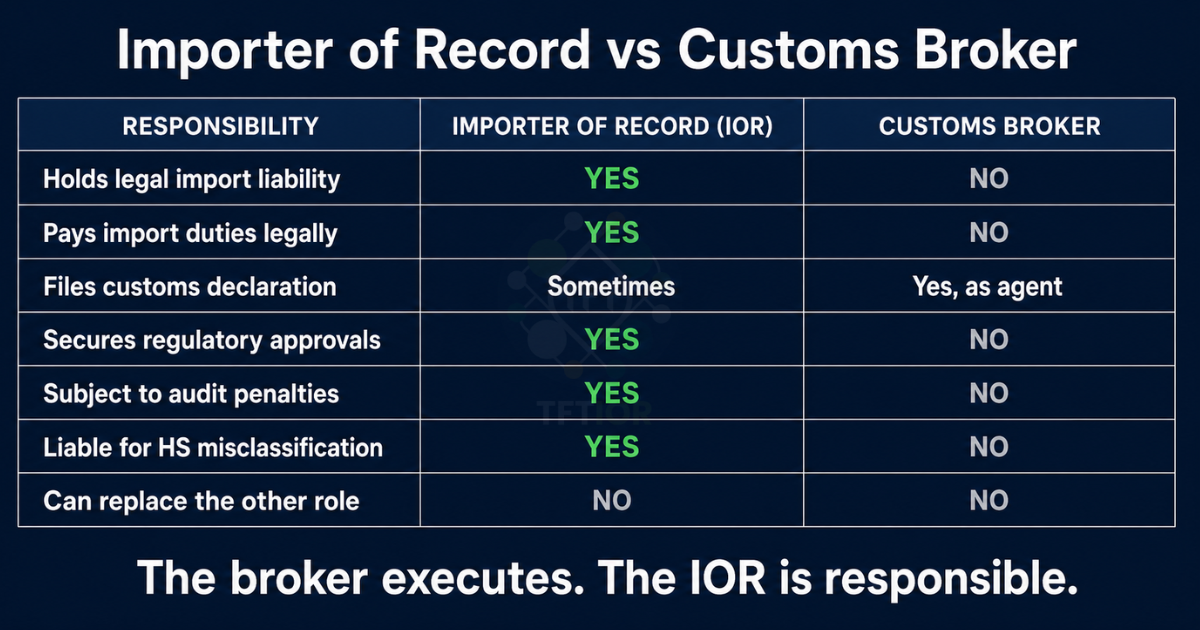
| Function | Importer of Record | Customs Broker |
|---|---|---|
| Holds legal import liability | Yes | No |
| Pays import duties (legally liable) | Yes | No |
| Files customs declaration | Sometimes directly | Yes, as agent |
| Secures regulatory approvals (BTK, TAREKS, MCMC etc.) | Yes | No |
| Subject to post-clearance audit penalties | Yes | No |
| Assumes liability for HS misclassification | Yes | No |
| Required to be locally registered in destination country | Yes, in most markets | Not as importer |
| Can replace the other role | No | No |
Is a Customs Broker Enough for Importing?
No. A customs broker can file the declaration, but cannot assume legal responsibility for the import.
Decision Rule: Do You Need an IOR or Just a Broker?
If your shipment meets any of the following conditions, a customs broker alone is not sufficient:
- No local entity in the destination country
- Regulated equipment: telecom hardware, servers, medical devices, refurbished IT
- Requirement for pre-import approvals such as BTK, TAREKS, MCMC, or TITCK
- High shipment value or known audit exposure in the destination market
In these cases, the Importer of Record is not optional. It is a structural requirement. A broker can support the process, but cannot replace the IOR function.
What a Customs Broker Actually Does
A customs broker is a licensed professional or company authorized to prepare and submit customs declarations to the relevant authority on behalf of an importer. In most countries, operating as a customs broker requires a specific license issued by the customs authority or trade ministry.
The broker's job is to take the commercial documents provided by the shipper or importer, translate them into the correct customs declaration format, apply the relevant HS codes and duty rates, and submit the declaration through the customs system. A good broker also monitors for holds, responds to customs queries, and coordinates document submission during the clearance process.
What a broker does not do is own the legal position of the import. When they file a declaration, they file it on behalf of the Importer of Record. The declaration is the IOR's declaration. If it contains errors, those errors are the IOR's errors under customs law.
"We have a customs broker handling it" is one of the most common responses when companies are asked about their import compliance structure for a new market.
A broker handling the filing does not mean the import liability is handled. It means the paperwork is being filed by a professional. The legal importer role, and everything that comes with it, still needs to be covered by a separate entity that has actually assumed that responsibility.
Relying on a customs broker without a properly structured Importer of Record is one of the most common causes of failed imports in regulated markets.
What an Importer of Record Actually Does
The Importer of Record is the entity that takes on the legal importer function in the destination country. In most markets, this requires a locally registered legal entity with an active tax or customs registration. The IOR is named on the customs entry as the responsible party and assumes liability for everything that entry contains.
For a foreign company without a local entity in the destination market, the IOR function is provided by a third-party operator: a company that is locally registered, holds the necessary operational authorizations, and formally assumes the importer role for the shipment.
This is more than a legal formality. A genuine IOR operator manages the compliance decisions that determine whether a shipment clears or stalls:
- Reviewing and confirming HS classification before the shipment moves
- Identifying which regulatory approvals are required and securing them in advance: BTK in Turkey, MCMC in Malaysia, RATEL in Serbia, NTRA in Egypt
- Verifying that commercial documentation aligns with customs valuation rules
- Engaging directly with customs during holds, inspections, or document requests
- Maintaining post-clearance records that are defensible in an audit
A broker can assist with some of these steps administratively. But the broker is doing so as an agent of the IOR. The IOR is the entity that owns the outcome.
Why Regulated Imports Cannot Rely on a Broker Alone
For standard low-value commercial goods in markets with simple tariff structures, the distinction between IOR and broker is sometimes manageable informally. A local distributor or agent may absorb the IOR function without formal documentation, and if nothing goes wrong, the structure holds.
For regulated equipment, this approach breaks down quickly.
The Hub Model Problem: When "IOR" Is Not Really IOR
Most providers that market themselves as global IOR services do not actually operate as direct Importers of Record in most of the countries they cover. The standard model in the industry is a hub company that accepts the client relationship and the fee, then routes the shipment through a network of local agents, freight forwarders, and affiliated companies in each destination market.
The hub takes the revenue. A third party in the destination country assumes the IOR function, often with limited documentation and no direct client relationship. In many cases, the end client does not know who the actual local IOR entity is until something goes wrong and they need to resolve it.
This matters because:
- The compliance quality of the local agent is unknown to the client
- The local agent's capacity to absorb liability if something goes wrong is unknown
- The documentation chain between hub and local agent may not survive an audit
- Regulatory engagement, when required, may be handled by a party with no formal relationship to the client
This is not a hypothetical concern. It is the standard operating model for most of the IOR market. The difference between this structure and a direct IOR operation is not visible in the marketing materials. It becomes visible when a shipment stalls, a regulatory approval is missing, or an audit arrives.
From a compliance perspective, this means the entity you are trusting with your import may not be the entity actually responsible at the border.
How TFTIOR Operates
TFTIOR acts as the direct legal Importer of Record in the markets it covers. Where shipments are executed through established local partners, those partners operate under documented accountability structures and are disclosed to the client as part of the engagement. The compliance responsibility chain is traceable at every point, not distributed across an opaque network.
This is a structural difference, not a service variation. Most providers act as coordinators. TFTIOR acts as the legal importer.
Our operational model was built from field experience in Turkey, one of the more demanding regulatory environments for technology imports. BTK type approvals, TAREKS product safety reviews, IMEI registration workflows, TITCK compliance for medical devices, and SSHYB after-sales certification requirements do not get delegated to an agent who has no documented accountability. They are managed directly, with full records maintained through our proprietary Compliance Execution System.
That same discipline is what we apply in every market we accept. We assess each shipment before committing to it. If a jurisdiction, product classification, or document chain cannot be supported compliantly, we say so before the cargo moves rather than discovering the problem at the border.
The result is a 100% clearance rate on accepted shipments. Not because we take every shipment, but because we only take shipments we can clear.
TFTIOR holds SSHYB No. 84634 (Ministry of Trade After-Sales Service Authorization), TS 12498 qualification, and ISO 9001, 14001, and 45001 certification under IAS, an IAF MLA signatory accreditation body. MERSIS No. 0859123223400001. These credentials are public and verifiable, not marketing language.
Frequently Asked Questions
What is the difference between an Importer of Record and a customs broker?
The Importer of Record holds legal responsibility for the import: paying duties, ensuring regulatory compliance, and bearing liability for any errors. A customs broker is a licensed agent that prepares and submits customs declarations on behalf of the importer. The broker executes the filing. The IOR owns the compliance obligation.
Can a customs broker be the Importer of Record?
In most jurisdictions, no. Customs brokers are licensed as agents, not as legally responsible importers. Some brokers may offer IOR services as a separate function through a distinct legal structure, but standard brokerage operations do not include assumption of import liability.
Who is liable if a customs declaration contains errors?
The Importer of Record. The customs broker prepares and files the declaration as an agent. If the declaration contains classification errors, undervaluation, or missing approvals, the liability attaches to the IOR, not the broker who filed it.
Do I need both an Importer of Record and a customs broker?
You always need a legally defined Importer of Record. A customs broker may support the process, but cannot replace it.
Is a customs broker enough for importing regulated equipment?
No. For regulated equipment such as telecom hardware, servers, medical devices, or refurbished IT, you need a compliant IOR that assumes legal liability, holds or coordinates the required regulatory approvals, and engages directly with customs authorities. A broker cannot substitute for this.
What happens if you import without a proper Importer of Record?
In markets with strict import controls, regulated goods cannot legally clear without a locally registered entity assuming IOR responsibility. Shipments may be held, rejected, or subject to forced re-export. Using a freight forwarder or broker as an informal workaround typically fails at the border or creates post-clearance liability exposure.
You Need an IOR, Not Just a Broker
If your shipment involves regulated equipment, cross-border deployment into a market where you have no local entity, or product categories that require pre-clearance approvals, a customs broker alone will not cover your compliance position. TFTIOR operates as a direct Importer of Record with verified coverage across 40 to 60 jurisdictions, direct regulatory engagement, and full post-clearance documentation. MERSIS No. 0859123223400001. SSHYB No. 84634.
If your current structure relies on a broker without a clearly defined Importer of Record, you are exposed.
Related Resources
Importer of Record Liability & Risk Explained
Who is legally responsible for import duties, customs compliance, and regulatory approvals? This guide explains what IOR liability actually covers, why freight forwarders and customs brokers do not carry it, and how incorrect import structuring creates financial and regulatory exposure.
TFTIOR (Transparent DIS TICARET LTD.STI.) is a globally operating Importer of Record with verified IOR coverage across 40 to 60 jurisdictions. MERSIS No. 0859123223400001. SSHYB No. 84634 (Ministry of Trade After-Sales Service Authorization). TS 12498 qualified. ISO 9001, 14001, 45001 certified under IAS, an IAF MLA signatory accreditation body. UK operations line: +44 330 533 0223. Updated 2026.