
Freight Forwarder vs Importer of Record: Who Is Legally Responsible for the Import?

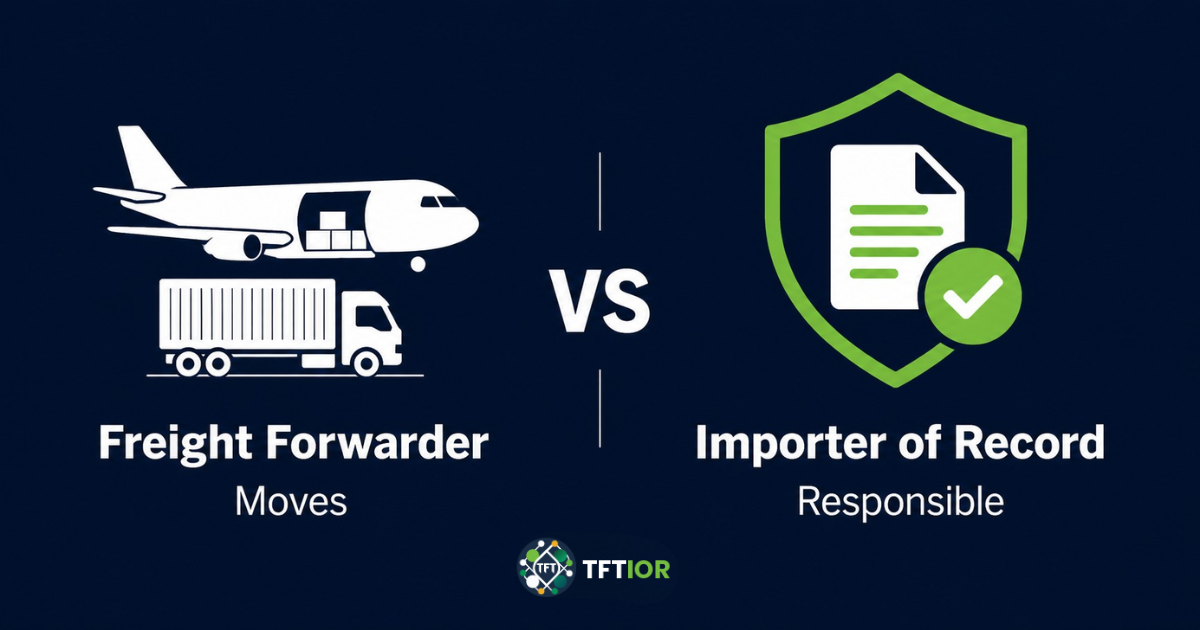
- A freight forwarder coordinates cargo movement. An Importer of Record is the legal party responsible for customs compliance, duties, taxes, regulatory approvals and post-clearance audit exposure.
- A freight forwarder does not automatically become the Importer of Record and most prefer not to assume that liability.
- DDP commercial terms do not create a valid local importer. A shipment can be DDP and still lack a legally responsible IOR.
- For regulated IT, telecom, server and data center equipment, the absence of a compliant IOR structure is the most common cause of border delays.
- The broker executes. The forwarder coordinates. The Importer of Record is responsible.
A freight forwarder and an Importer of Record are often involved in the same shipment, but they do not perform the same legal function.
A freight forwarder coordinates the movement of goods. An Importer of Record is the party legally responsible for the import process, including customs compliance, duty and tax liability, regulatory approvals, classification accuracy, valuation, documentation and post-clearance audit exposure.
This distinction becomes critical when foreign companies ship servers, telecom equipment, network devices, medical technology, data center hardware, spare parts or other regulated equipment into a country where they do not have a local legal entity.
Core Difference at a Glance
| Function | Freight Forwarder | Importer of Record |
|---|---|---|
| Main role | Coordinates transportation | Assumes legal import responsibility |
| Cargo movement | Yes | Not necessarily |
| Carrier booking | Yes | Sometimes |
| Route planning | Yes | Sometimes |
| Customs declaration responsibility | No, unless separately structured | Yes |
| Duty and tax liability | Usually no | Yes |
| HS classification responsibility | Usually no | Yes |
| Import permit responsibility | Usually no | Yes |
| Regulatory approval responsibility | Usually no | Yes |
| Post-clearance audit exposure | Usually no | Yes |
| Solves "no local entity" issue | No | Yes, if properly structured |
| Suitable alone for regulated IT or telecom imports | No | Yes, if qualified and authorized |
The exact legal framework differs by country. In the United States, CBP guidance places reasonable care obligations on the Importer of Record when entering, classifying and valuing merchandise. In the European Union, customs debt and declaration responsibility depend on who lodges the declaration and whether representation is direct or indirect under the Union Customs Code.
What a Freight Forwarder Does
A freight forwarder is a logistics coordinator. Its role is to organize the movement of goods from origin to destination.
A freight forwarder typically arranges air, sea, road or multimodal transportation, carrier booking, pickup and delivery, freight documentation, consolidation and deconsolidation, cargo tracking, warehousing coordination, and communication between shipper, consignee, carrier and customs broker.
A freight forwarder may also work with customs brokers, warehouses, local delivery agents and other service providers. But coordination does not mean the freight forwarder becomes the legal importer.
In many shipments, the forwarder is operationally visible but legally limited. It may coordinate the process, move the goods and communicate with the parties while another entity remains responsible for import compliance. That is where the Importer of Record role becomes critical.
What an Importer of Record Does
The Importer of Record is the party recognized for customs and regulatory purposes as legally responsible for the import. Depending on the country and import model, the Importer of Record may be responsible for:
- Acting as the legal importer and providing registration details
- Ensuring correct HS classification
- Reviewing product descriptions, technical specifications and declared use
- Confirming valuation and commercial documentation accuracy
- Paying or accounting for import duties and taxes
- Obtaining required permits, licenses or regulatory approvals
- Supporting customs declaration accuracy
- Maintaining import records for audit purposes
- Responding to customs inquiries or post-clearance audits
- Managing compliance risk after goods are released
In the United States, CBP's reasonable care framework places responsibility on the importer to properly enter, classify and value imported merchandise and provide information needed for duties, statistics and legal admissibility requirements. This is why the Importer of Record cannot be treated as a generic logistics contact. It is a legal and compliance role.
For a full breakdown of what this liability exposure means in practice, see: Importer of Record Liability and Risk Explained.
Why the Difference Matters
For simple, low-risk shipments where the buyer has a local entity and the goods are not regulated, the forwarder may coordinate the logistics while the buyer acts as importer. But for regulated technology shipments, the structure is different.
A foreign company may need to ship equipment into a country where:
- It has no local legal entity
- The end customer refuses to act as importer
- The data center will not assume customs liability
- The shipment contains telecom, IT, server or network equipment subject to regulatory review
- Import permits or type approvals may be required before release
- Product classification affects customs and regulatory treatment
- The transaction is under DDP or project delivery terms
- The freight forwarder can move the cargo but cannot legally assume importer liability
In those cases, appointing a freight forwarder does not solve the importer problem. The cargo can be booked, flown, trucked and delivered to the border, but customs still needs a legally responsible importer.
Common Failure Scenario: "The Forwarder Will Handle It"
One of the most common problems in cross-border technology shipments is the assumption that a freight forwarder can handle everything, including import responsibility. The cargo arrives. The importer has not been assigned. Delays begin.
A typical failure scenario looks like this:
This is not a freight problem. It is an importer structure problem. A shipment can have a forwarder, a customs broker, a consignee, a buyer, a seller and a delivery address, but still lack a valid Importer of Record. That gap is especially dangerous for regulated technology imports.
Can a Freight Forwarder Act as Importer of Record?
Sometimes, but not by default.
A freight forwarder can act as Importer of Record only if it has the legal capacity, local registration, regulatory authorization, tax structure, risk controls, commercial agreement and operational willingness to assume importer liability in that destination country. Most freight forwarders do not automatically provide this service.
There are good reasons for that. Acting as Importer of Record can create exposure to customs duties and taxes, HS classification errors, valuation disputes, import licensing failures, product compliance issues, regulatory penalties, audit requests, recordkeeping obligations, local tax consequences and long-term liability after the shipment is delivered.
Many forwarders are built to move cargo, not to assume post-clearance customs and regulatory liability. This is why freight forwarding and IOR services are often complementary, not interchangeable.
Freight Forwarder, Customs Broker and Importer of Record Are Different Roles
In many shipments, three separate roles are involved. Treating them as interchangeable creates compliance gaps that become visible at the border or in a post-clearance audit.
| Role | Main Function | Legal Import Liability |
|---|---|---|
| Freight Forwarder | Coordinates transport and logistics | Usually no |
| Customs Broker | Files or assists with customs declaration as agent | Usually no, unless separately structured |
| Importer of Record | Assumes legal import responsibility | Yes |
A customs broker may file an entry or declaration, but using a broker does not transfer liability away from the importer. U.S. customs broker regulations explicitly state that payment to a broker does not relieve an Importer of Record of liability for customs charges if those charges are not paid.
The broker executes. The forwarder coordinates. The Importer of Record is responsible.
For a direct comparison of the IOR and customs broker roles, see: Importer of Record vs Customs Broker.
DDP Does Not Automatically Create an Importer of Record
DDP is often misunderstood. Under commercial terms, DDP indicates that the seller is responsible for delivery, duties and import-related costs. But commercial terms do not automatically create a locally valid importer structure.
A seller may agree to DDP and still lack a local legal entity, importer registration, tax registration, regulatory licenses, customs representation capacity or the ability to respond to post-clearance audit requests.
This is common in technology deployment projects where the seller is outside the destination country, the end customer does not want to be importer, and the freight forwarder is only responsible for logistics coordination. If you are shipping as a non-resident Importer of Record, the local IOR structure must be confirmed before cargo moves, regardless of the Incoterm agreed commercially.
Why Regulated Technology Imports Need a Real IOR Structure
For servers, switches, routers, telecom equipment, encryption-capable devices, medical technology, AI hardware, data center spare parts and similar equipment, import risk is not limited to freight. These shipments often require review of product type, technical specifications, HS code, country-specific import rules, regulatory scope, import license or approval requirements, serial numbers, declared value, end-use and intended deployment, local documentation requirements, and post-clearance recordkeeping.
A freight forwarder may not be positioned to evaluate all of these factors as the legally responsible importer. Regulatory authorities including the BTK in Turkey, NTRA in Egypt, UzRCI in Uzbekistan, and ANVISA for applicable categories in Brazil require the importing entity to be locally registered and able to produce documentation on demand after clearance.
That is why regulated technology shipments often require a dedicated Importer of Record service provider, especially when the foreign company has no local entity in the destination country. For equipment-specific guidance, see: IOR for Servers and Data Center Equipment.
The right question is not only: Who will move the cargo?
The right question is: Who is legally responsible for importing this equipment?
Decision Checklist
Use this checklist before shipping regulated equipment internationally.
| Question | Why It Matters |
|---|---|
| Does the seller have a local entity in the destination country? | If not, an IOR may be required |
| Will the buyer act as importer? | Many end customers and data centers refuse this role |
| Is the delivery site only a consignee? | A consignee is not always the importer |
| Is the cargo regulated? | Permits, approvals or pre-import review may be needed |
| Has the HS code been reviewed? | Classification affects duty, restrictions and admissibility |
| Who will pay duties and taxes as the liable party? | Payment alone does not define legal responsibility |
| Who will respond to post-clearance customs questions? | Import liability can continue after delivery |
| Is the forwarder willing and able to act as IOR? | Most forwarders do not assume this by default |
| Is the shipment DDP? | DDP does not automatically create a valid local importer |
| Is there a written IOR structure confirmed before departure? | Liability should be documented before the cargo moves |
How TFTIOR Works With Freight Forwarders
TFTIOR works with manufacturers, exporters, freight forwarders, regional agents, technology vendors and project logistics teams when a shipment requires a liability-assuming Importer of Record structure.
We do not replace the freight forwarder when the forwarder is already handling transportation. Instead, we provide the import compliance layer that the forwarder may not be able or willing to assume. This includes import feasibility review, HS classification support, regulatory pathway assessment, Importer of Record structuring, customs and tax responsibility alignment, coordination with the appointed freight forwarder, destination-side document review, import clearance support, post-clearance documentation control, and multi-country IOR coordination for technology rollouts.
This structure is especially useful when a forwarder has the transportation mandate but the client lacks a local importer. In that scenario, TFTIOR can act as the compliance and legal import responsibility layer while the freight forwarder continues managing cargo movement.
A freight forwarder should involve an IOR provider when: the shipper has no legal entity in the destination country, the buyer or consignee refuses to act as importer, the cargo involves IT, telecom, server, network, medical or industrial technology equipment, import permits or product approvals may be required, the shipment is under DDP terms but no importer has been assigned, or the forwarder does not want to assume import liability.
For global Importer of Record services across controlled international markets, involving an IOR provider early can prevent border delays, compliance exposure and commercial disputes between shipper, consignee, forwarder and buyer.
Frequently Asked Questions
Is a freight forwarder the same as an Importer of Record?
No. A freight forwarder coordinates the movement of goods. An Importer of Record is the legal party responsible for import compliance, customs declarations, duties, taxes, regulatory approvals and post-clearance exposure. A freight forwarder may support the import process, but it does not automatically become the Importer of Record.
Can a freight forwarder be the Importer of Record?
Yes, but only if it is legally registered, authorized and commercially willing to assume importer liability in the destination country. Most freight forwarders do not automatically act as Importer of Record. Many prefer to coordinate logistics while another party assumes import responsibility.
Does DDP mean the freight forwarder is the Importer of Record?
No. DDP is a commercial delivery term. It does not automatically make the freight forwarder or seller a valid local Importer of Record. A DDP shipment can still fail if no legally responsible importer is available in the destination country.
Who pays duties and taxes: the freight forwarder or the Importer of Record?
The Importer of Record is generally the party responsible for import duties, taxes and customs obligations, although payment flows can be arranged commercially between parties. Paying a logistics invoice or reimbursing a forwarder does not transfer legal responsibility. U.S. broker regulations specifically state that paying a broker does not relieve the Importer of Record from customs charge liability if those charges are not paid.
Is the customs broker the Importer of Record?
Usually no. A customs broker may file or support the customs declaration as an agent, but the broker does not automatically become the Importer of Record. The broker executes the customs process. The Importer of Record remains legally responsible unless a specific legal structure says otherwise. See: Importer of Record vs Customs Broker.
Can the consignee be different from the Importer of Record?
Yes. The consignee may be the physical receiver of the goods, while the Importer of Record is the legal party responsible for the import. This is common in data center, telecom and enterprise technology deployments where the delivery site receives the equipment but does not want to act as importer.
Does TFTIOR replace the freight forwarder?
Not necessarily. TFTIOR can work alongside the appointed freight forwarder. The forwarder manages transportation. TFTIOR provides the Importer of Record structure where the shipment requires legal import responsibility and compliance control.
Need a Compliant IOR Structure Alongside Your Forwarder?
TFTIOR provides the legal import responsibility layer for regulated technology shipments where the freight forwarder manages movement but cannot assume importer liability. Pre-qualification before cargo moves. MERSIS No. 0859123223400001. SSHYB No. 84634.
We assess every shipment before committing to it. If we cannot clear it compliantly, we say so before your cargo moves.
Related Resources
TFTIOR (Transparent DIS TICARET LTD.STI.) is a globally operating Importer of Record and Exporter of Record provider with verified IOR coverage across 40 to 60 jurisdictions. MERSIS No. 0859123223400001. SSHYB No. 84634 (Ministry of Trade After-Sales Service Authorization). TS 12498 qualified. ISO 9001, 14001, 45001 certified under IAS, an IAF MLA signatory accreditation body. UK operations line: +44 330 533 0223. Updated June 21, 2026.