
Non-Resident Importer of Record: How to Import When You Have No Local Entity

- Foreign companies without a local entity in the destination country cannot legally be named as the Importer of Record in most markets.
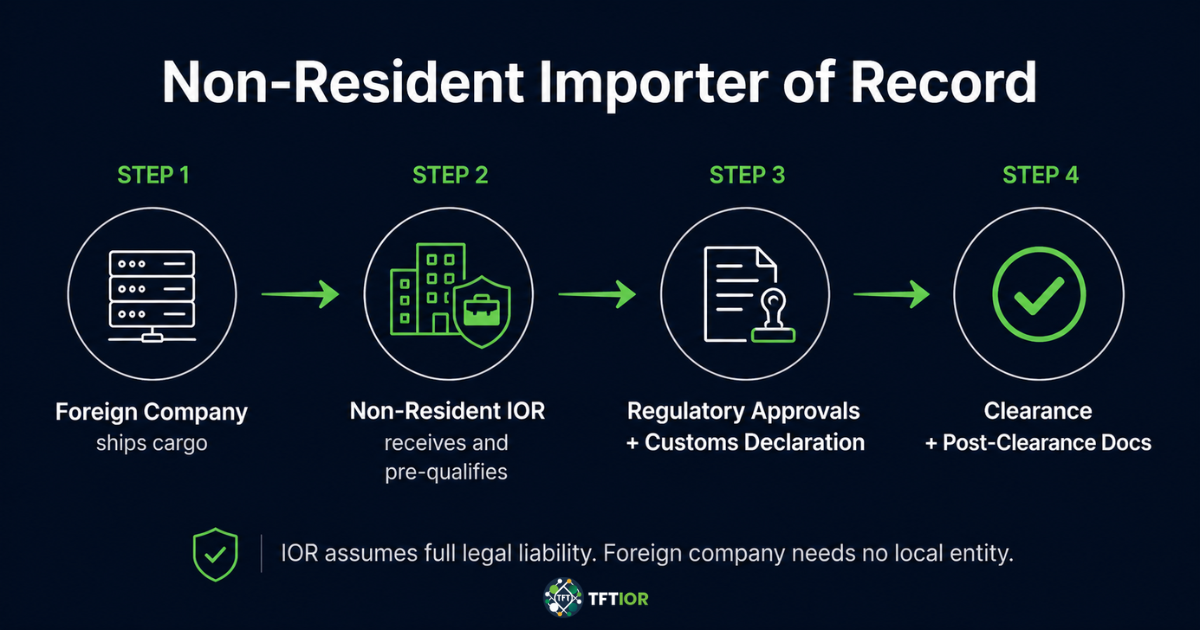
- A non-resident IOR is a locally registered third-party company that assumes the full legal importer function on behalf of the foreign shipper.
- For servers, networking equipment, GPU clusters, and data center infrastructure, the non-resident IOR must manage pre-import regulatory approvals — not just file the customs entry.
- Providers that skip pre-qualification create the conditions for border failures. The foreign company finds out when the shipment stalls.
- A paper IOR is named on the customs documentation but has no operational capacity to manage compliance. The structure looks correct until something goes wrong.
- TFTIOR pre-qualifies every shipment before committing to it. If a shipment cannot be cleared compliantly, we say so before the cargo moves.
If you need to import servers, networking equipment, or data center infrastructure into a country where you have no local entity, you cannot legally act as the Importer of Record. A non-resident IOR provides the required local legal importer function, allowing your shipment to clear compliantly without establishing a local company in the destination market.
This is not a paperwork gap. It is a legal requirement. In markets with regulated import controls — Turkey, Saudi Arabia, Vietnam, Brazil, Egypt, and others — a shipment without a properly structured Importer of Record does not clear customs. It is held, rejected, or subject to forced re-export. The non-resident IOR model exists to solve exactly this problem, and the way it is structured determines whether the compliance holds or fails at the border.
The Structural Problem: No Local Entity, No Legal Importer
Most global hardware deployments do not justify the cost, timeline, or operational overhead of establishing a local subsidiary in every destination country. Setting up a legal entity in a regulated market such as Turkey or Saudi Arabia typically takes several months, requires ongoing tax registration, accounting, and compliance obligations, and creates permanent commercial exposure in the jurisdiction. For a one-time deployment, a recurring hardware refresh cycle, or an initial market entry that does not yet require a permanent commercial presence, the entity setup cost and timeline are disproportionate.
At the same time, the import cannot proceed without a local legal entity assuming the IOR role. The gap between "we don't have a local company" and "customs requires one" is where non-resident IOR services operate.
The non-resident IOR provides the local legal presence without requiring the foreign company to establish one. This distinction matters across the compliance chain: the IOR is named on the customs entry as the responsible importer, assumes liability for duties, taxes, and regulatory compliance, manages pre-import approvals, and owns the clearance outcome. Once the shipment clears, goods are transferred to the receiving entity under the agreed commercial terms.
What a Non-Resident Importer of Record Is
A non-resident importer of record is a third-party company that is locally registered in the destination market and formally assumes the full legal importer function on behalf of a foreign organization that has no presence there.
The term "non-resident" refers to the shipper's status, not the IOR's. The IOR itself must be locally resident — registered, tax-compliant, and operationally active in the destination country. The "non-resident" descriptor means the IOR service is being provided to a company that does not have its own local entity and therefore needs a third party to fill that role.
This is a distinct service from freight forwarding, customs brokerage, and logistics coordination. Those services support the import process administratively. The non-resident IOR owns the legal position of the import. If the declaration contains errors, if a regulatory approval is missing, or if the declared value is challenged in an audit, the non-resident IOR is the entity that customs authorities hold accountable. That liability is the core of what the service provides — and the core of what distinguishes a compliant IOR from a paper IOR.
For a fuller explanation of how the Importer of Record role is defined under customs law, see our guide: What Is an Importer of Record?
How the Non-Resident IOR Model Works in Practice
The engagement typically begins before the shipment moves. A compliant non-resident IOR reviews the product, the documentation chain, the destination market, and the applicable regulatory requirements before committing to the shipment.
This pre-qualification step is where the model either holds or breaks down. Providers that skip it create the conditions for border failures — a regulatory approval is missing, the HS classification is incorrect, the declared value does not align with customs benchmarks. The shipment stalls at the border, and the cost of resolution falls on the foreign company that assumed the IOR had it covered.
A properly structured non-resident IOR engagement works as follows:
The difference between a non-resident IOR and a customs broker is that the broker executes the declaration as an agent. The IOR owns the compliance outcome. If the broker files an incorrect declaration, liability rests with the IOR that authorized it, not the broker that submitted it.
Why IT and Data Center Hardware Requires This Structure
Standard commercial goods moving through markets with straightforward tariff structures sometimes tolerate informal import arrangements. Regulated technology equipment does not.
Servers, networking switches, routers, storage arrays, GPU clusters, and data center power and cooling infrastructure are classified under HS chapters that trigger additional regulatory scrutiny in most markets. Equipment that incorporates radio frequency components — which includes virtually all networking hardware — requires type approval from the national telecom regulator before it can legally enter the market. Equipment that uses encryption requires classification review under export control frameworks in the origin country and, in some markets, import controls in the destination. Dual-use technology adds a further layer that must be assessed before the cargo moves.
For data center deployments specifically, the volume and declared value of equipment involved means that any classification error or missing approval creates material financial exposure. Customs authorities benchmark declared values for server and storage equipment against market databases. If the declared value is challenged, the Importer of Record is responsible for defending it with supporting documentation. A broker or freight forwarder cannot absorb this exposure. A properly structured non-resident IOR can, because it reviewed the documentation chain before the cargo moved.
The regulatory requirements by product category in key markets:
For a detailed breakdown of IOR requirements by equipment type across data center deployments, see: Importer of Record for Servers and Data Center Equipment.
Key Markets Where Non-Resident IOR Is Most Consequential
Non-resident IOR is relevant in any market where a foreign company cannot be named as the legal importer. In practice, the markets where the absence of a compliant IOR creates the highest operational risk are those that combine regulatory complexity with consistent enforcement. These markets are not difficult because of documentation volume alone — they are difficult because enforcement is consistent and audit risk is real. A failed clearance in Turkey or Saudi Arabia is not resolved with a phone call.
Turkey is among the most demanding environments for technology imports. BTK type approval is required for telecom and radio-capable equipment. TAREKS manages product safety reviews across a broad range of electronics. IMEI registration is required for mobile and network-capable devices. The SSHYB after-sales service authorization applies to equipment categories that include data center hardware. A non-resident IOR operating in Turkey without these registrations is not in a position to manage the compliance chain. TFTIOR holds SSHYB No. 84634 and TS 12498 qualification. For a full overview: Importer of Record Turkey — Complete Guide.
Saudi Arabia applies CITC approval for telecom and radio equipment, SASO conformity assessment for electronics, and has increasingly structured documentation requirements for technology imports. SASO requirements have expanded in recent years, and shipments without pre-approval documentation face a higher probability of customs holds.
Brazil requires ANATEL approval for radio-capable equipment and INMETRO compliance for regulated electronics. Brazil also applies ICMS state-level tax in addition to federal import duties, which must be handled correctly by the IOR. For detail: Brazil IOR.
Vietnam requires Ministry of Information and Communications type approval for telecom equipment. The approval process runs separately from the customs declaration and must be completed before the shipment can clear. For detail: Vietnam IOR Requirements.
Egypt applies NTRA approval for telecom equipment and has applied additional import controls to technology categories under its customs modernization program. For detail: Egypt IOR.
Markets including Malaysia (MCMC), Philippines (NTC), Kazakhstan (ARCD), and Uzbekistan (UzRCI) apply similar requirements with jurisdiction-specific regulatory frameworks. For regulated technology deployments across multiple markets simultaneously, see: Importer of Record for Regulated Technology Global Deployments.
The Paper IOR Risk in Non-Resident Scenarios
A paper IOR is a provider that agrees to be named as the Importer of Record on customs documentation without having the registrations, operational capacity, or intent to actually manage the import compliance. The arrangement exists on paper. The regulatory engagement, the approval coordination, and the liability absorption do not.
Paper IOR arrangements are particularly common in the non-resident IOR market because the client is a foreign company with limited visibility into what the provider is actually doing in the destination country. The provider is locally registered, so the customs declaration appears technically correct. But if a regulatory approval is missing, if the HS classification is wrong, or if the declared value is challenged in an audit, the paper IOR has no capacity to resolve it.
The hub model is the most widespread form of paper IOR. A provider markets global IOR coverage, accepts the client relationship and the fee, then routes each shipment through unnamed local agents in the destination country. The client does not know who the actual local IOR entity is. The local agent may have no documented accountability to the client, no verified compliance capacity, and no relationship with the relevant regulatory bodies.
This structure is not visible in the provider's marketing materials. It becomes visible when a shipment stalls at the border and the provider has no direct answer about what the local agent is doing to resolve it.
A compliant non-resident IOR can be identified by a few verifiable markers: it holds documented registrations in the markets it covers, it can name the specific regulatory bodies it engages with and describe the approval processes it manages, it reviews the shipment before committing to it, and it provides post-clearance documentation that is traceable in a customs audit. If a provider cannot provide these answers directly, the non-resident IOR function it is offering may be paper-only.
What Happens Before Your Cargo Moves
The pre-qualification step is where the non-resident IOR model either delivers or fails. It is also where most of the operational value is generated.
Before TFTIOR commits to a shipment, we review the product classification to confirm the applicable HS code and duty rate in the destination market. We identify every regulatory approval required for the product type and market combination — type approvals, safety certifications, IMEI registrations, and any product-specific requirements. We verify that the commercial documentation chain is consistent with customs valuation rules. We check for any export control considerations on the origin side that would affect clearance in the destination.
If the shipment cannot be cleared compliantly — because the product lacks a required approval, because the documentation cannot be structured correctly, or because the destination market presents a compliance risk that cannot be managed within the engagement — we say so before the cargo moves. This is the operational basis of our 100% clearance rate on accepted shipments. We do not accept shipments we cannot clear.
For companies that have experienced a stuck shipment in a regulated market, this pre-qualification discipline is often what was missing from the previous IOR arrangement.
How TFTIOR Operates as a Non-Resident IOR
TFTIOR acts as the direct legal Importer of Record in the markets it covers. Where local partners are involved in specific jurisdictions, those partners operate under documented accountability structures and are disclosed to the client as part of the engagement. The compliance chain is traceable at every point, not distributed across an opaque network.
Our operational foundation was built in Turkey, which is among the more demanding regulatory environments for technology imports globally. BTK type approvals, TAREKS product safety reviews, IMEI registration workflows for network-capable devices, and SSHYB after-sales certification requirements are managed directly through our established regulatory relationships — not delegated to undisclosed agents.
We apply the same pre-qualification discipline to every market we accept. A foreign company using TFTIOR as its non-resident IOR for a data center hardware deployment or a technology infrastructure rollout does not need to understand the local regulatory framework in the destination market. It needs to provide accurate product and commercial documentation. We handle the compliance structure.
TFTIOR holds SSHYB No. 84634 (Ministry of Trade After-Sales Service Authorization), TS 12498 qualification, and ISO 9001, 14001, and 45001 certification under IAS, an IAF MLA signatory accreditation body. MERSIS No. 0859123223400001. These credentials are public and verifiable. UK operations line: +44 330 533 0223.
In a documented multi-country rollout across nine jurisdictions, shipments initially structured without a compliant non-resident IOR failed to clear in two markets due to missing telecom type approvals — approvals the logistics provider had not identified as required. The structure was rebuilt under a direct non-resident IOR model. Synchronized clearance across all nine destinations was achieved in the subsequent deployment cycle. See: Multi-Country Rollout Case Study.
For additional hardware deployment scenarios, see: TFTIOR Case Studies. For a comparison of the non-resident IOR approach versus establishing a local entity, see: Importer of Record vs Local Entity Setup.
Frequently Asked Questions
What is a non-resident importer of record?
A non-resident importer of record is a locally registered company that assumes the legal importer function on behalf of a foreign organization that has no legal entity in the destination country. The non-resident IOR is named on the customs entry as the responsible importer, pays applicable duties and taxes, manages required regulatory approvals, and bears legal liability for the import. Once the shipment clears, ownership of the goods transfers to the receiving entity under the agreed commercial terms.
Can I import hardware into a new market if I have no local entity there?
In most regulated markets, no. Customs authorities require a locally registered entity to be named as the Importer of Record. A foreign company without a local presence cannot legally assume this role. A non-resident IOR service provides the local legal importer function, allowing the foreign company to clear shipments without establishing a subsidiary or permanent establishment in the destination country.
What is the difference between using a non-resident IOR and setting up a local entity?
Establishing a local entity gives a company permanent commercial presence and the ability to act as its own Importer of Record on an ongoing basis. It is appropriate when permanent operations in the market are planned. A non-resident IOR provides the local legal importer function without the overhead of entity formation — no multi-month setup, no ongoing compliance obligations, no permanent local tax exposure. It is appropriate for one-time shipments, recurring deployment cycles, and initial market entry where a permanent local presence is not yet warranted. For a full comparison, see: Importer of Record vs Local Entity Setup.
Do I need a non-resident IOR for every shipment or only in certain markets?
The requirement depends on the destination market and the product type. In markets with strict import controls, a locally registered entity must be named as the Importer of Record for any regulated shipment. For IT and data center hardware, telecom equipment, and dual-use technology, this requirement applies in virtually every market that maintains meaningful customs enforcement. The non-resident IOR model is most critical in Turkey, Saudi Arabia, Brazil, Vietnam, Egypt, and Malaysia, though the underlying legal requirement exists across most import jurisdictions.
What types of IT and data center equipment require a non-resident IOR?
Servers, networking switches, routers, storage arrays, GPU clusters, UPS systems, and structured cabling infrastructure all require a compliant Importer of Record in regulated markets. Equipment incorporating radio frequency components — which includes most networking hardware — additionally requires type approval from the national telecom regulator. Equipment using encryption may require export license review at origin and import controls in the destination. A non-resident IOR operating in these product categories must be able to manage these regulatory requirements, not just file the customs entry.
How do I verify that a non-resident IOR provider is compliant rather than a paper IOR?
A compliant non-resident IOR can name the specific regulatory bodies it engages with in each market, describe the approval processes it manages for IT and telecom equipment, and provide verifiable registrations and credentials. It reviews the shipment before committing to it and declines shipments it cannot clear compliantly. It provides post-clearance documentation that is traceable and defensible in a customs audit. A paper IOR, by contrast, agrees to be named on customs documentation without operational capacity to manage compliance. The difference becomes visible when a shipment stalls or an audit arrives.
Import Without a Local Entity — Done Compliantly
If your shipment involves IT or data center hardware entering a market where you have no local entity, TFTIOR operates as your direct legal Importer of Record. Pre-qualification before the cargo moves. Regulatory approval coordination. Full post-clearance documentation. MERSIS No. 0859123223400001. SSHYB No. 84634.
We assess every shipment before committing to it. If we cannot clear it compliantly, we say so before your cargo moves.
Related Resources
Importer of Record vs Local Entity Setup
When does using a non-resident IOR make more sense than establishing a local subsidiary? This guide compares the two approaches across cost, timeline, compliance obligations, and operational risk — with specific reference to regulated technology markets.
TFTIOR (Transparent DIS TICARET LTD.STI.) is a globally operating Importer of Record with verified IOR coverage across 40 to 60 jurisdictions. MERSIS No. 0859123223400001. SSHYB No. 84634 (Ministry of Trade After-Sales Service Authorization). TS 12498 qualified. ISO 9001, 14001, 45001 certified under IAS, an IAF MLA signatory accreditation body. UK operations line: +44 330 533 0223. Updated June 22, 2026.