
Procurement Guide · IOR Provider Evaluation · Data Center
How to Choose a Data Center IOR Provider
Selecting an Importer of Record provider for data center deployments is a compliance decision, not a logistics procurement exercise. The provider you appoint becomes the legal importer in each destination market, accountable for customs declaration accuracy, regulatory screening, duty and tax exposure, and the post-clearance audit trail. This guide covers the criteria that actually matter when evaluating IOR providers for server, GPU, networking, storage, and regulated technology deployments across multiple countries.

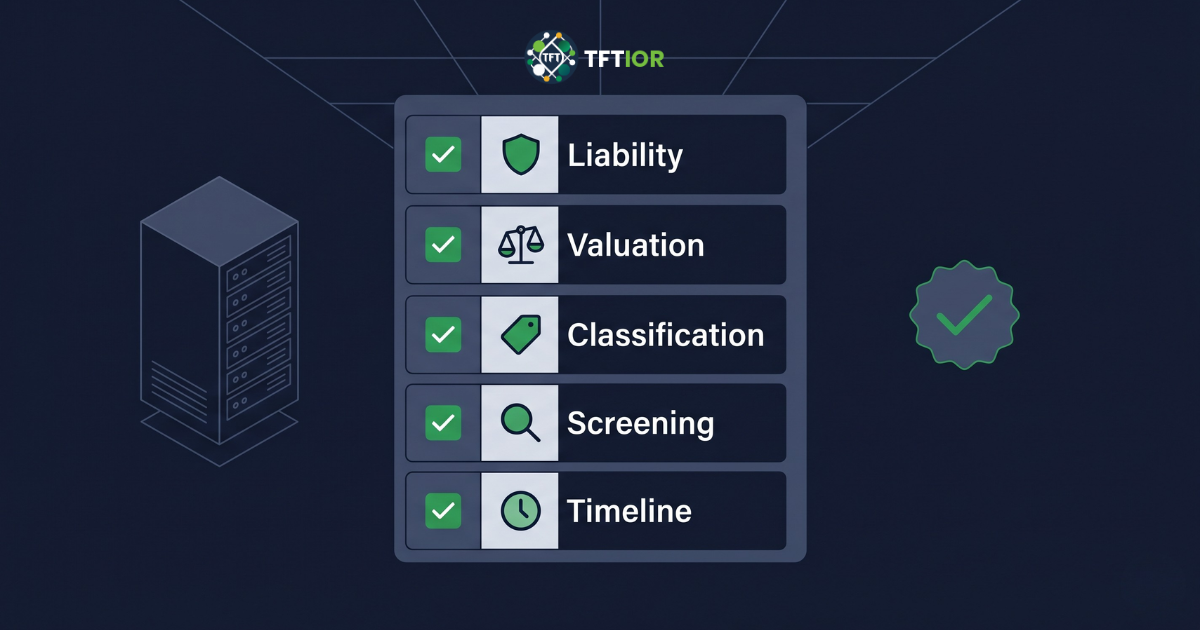
- IOR provider selection is a legal appointment, not a logistics comparison. The provider becomes the legal importer in each destination country, with direct accountability for customs declaration accuracy, duty and tax exposure, and post-clearance audit readiness.
- Country coverage claims in marketing materials are not importer standing. A provider may coordinate freight in many countries without being able to lawfully and accountably act as Importer of Record in each of them.
- Pre-shipment review is non-negotiable for data center equipment. HS classification risk, customs valuation issues, regulatory exposure, and export control screening must be resolved before cargo moves, not after it arrives at the destination customs.
- Timeline pressure is where IOR selection decisions go wrong. Providers that commit to deployments without reviewing the compliance file, because a deployment deadline is tight, are accepting risk they cannot control. The right provider delays or restructures when the compliance position is unclear, regardless of the timeline.
- The questions a provider cannot answer clearly are as important as the ones they can. Vague responses on importer identity, liability boundaries, and refusal processes are selection signals, not gaps to overlook.
Why IOR Provider Selection Matters for Data Center Deployments
A standard freight procurement process compares transit times, carrier options, port access, and cost. Those are real considerations. For a data center deployment moving servers, GPU clusters, network switches, storage arrays, or regulated telecom equipment across international borders, the freight variables are only part of the picture.
The other part is importer liability. Someone must legally act as importer in each destination country. That entity is responsible for the accuracy of the customs declaration, the classification of the goods, the valuation methodology used to calculate duties, the regulatory compliance of the equipment for that market, and the completeness of the import file if customs authorities review it later. That entity is not the freight forwarder by default. It is not the consignee unless they are structured to act as importer. It is not automatically the company named on the commercial invoice.
The IOR provider you appoint is that entity. In markets where you have no local legal presence, the IOR is the only party that can lawfully stand in as importer. The selection decision determines who controls the compliance file, who absorbs the liability exposure, and whether the import structure survives customs review, valuation questions, regulatory checks, and post-clearance audit.
For data center deployments specifically, the stakes are higher than for ordinary IT shipments. Equipment values are large. Deployment timelines are fixed. Infrastructure dependencies are real. A customs hold on a rack of GPU servers is not an inconvenience it can delay a data center go-live, breach a customer SLA, or block a capital project. The IOR provider selection decision deserves proportionate attention.
Data Center Imports Are Not Ordinary IT Shipments
Most IOR providers are comfortable with standard commercial electronics. A shipment of laptops, monitors, or office networking gear is, in most markets, a straightforward customs event. Data center equipment is different in ways that are not always visible from a freight perspective.
The complexity comes from the equipment itself. Servers and storage systems are straightforward in some markets and trigger detailed product file requirements in others. GPU and AI accelerator hardware is subject to US export control regulations that apply regardless of the shipping country. Network switches, routers, and firewalls often contain wireless or encryption capabilities that require type approval or conformity documentation before import. Telecom hardware may need regulator-specific certification before it can clear customs. UPS and power infrastructure components have their own product safety and efficiency certification requirements in certain markets.
Beyond the equipment categories, data center deployments often involve intra-group transfers, RMA replacement units, spare parts shipments alongside new equipment, and mixed-vendor packing lists where HS classification must be applied consistently across dozens of line items. Each of these adds a layer of complexity that a generic customs clearance model is not structured to handle.
The right IOR provider for data center work understands these distinctions. They have reviewed equipment files at this level of detail before. They know which markets require what documentation for which product types. And they know when a shipment needs to be restructured before export rather than after it reaches the destination port.
The First Question: Who Becomes the Legal Importer?
This question sounds obvious. In practice, it is the one that most frequently goes unanswered before a deployment is committed.
There are several parties in a typical international data center shipment: the manufacturer or OEM, the system integrator, the freight forwarder, a customs broker, possibly a reseller or channel partner, and the end-user organization that will receive and operate the equipment. None of these parties automatically becomes the legal importer simply by being involved in the transaction.
DDP delivery terms cause particular confusion here. Under DDP (Delivered Duty Paid), the seller bears the cost and risk of delivery to the destination including import duties. Many procurement teams read DDP and assume importer liability is resolved. It is not. DDP specifies who pays for delivery and duties. It does not specify who is the legal importer, who controls the customs declaration, who is accountable for HS classification accuracy, or who holds the post-clearance audit trail. A DDP shipment routed through a freight network without a clearly identified legal importer in the destination country leaves importer liability in an undefined state, regardless of what the Incoterms column says on the purchase order.
The question to ask every candidate IOR provider, before evaluating anything else, is: who is the specific legal importer entity in this destination country, and what is their legal standing as an importer there? A provider that cannot answer that question with specifics a named entity, a registration, a description of how importer standing is maintained in that market is not ready to act as your IOR.
Selection Criteria
The IOR must be able to lawfully act as importer in the specific destination country for the specific product type. This is not a blanket capability it varies by market, by equipment category, and sometimes by shipment value or intended use.
Legal standing means the provider has a recognized legal entity in the destination country, or operates through a disclosed, accountable local partner with a clear documented liability structure. "We have partners in 170 countries" is a logistics network claim, not an importer standing claim. The provider should be able to tell you who specifically acts as the legal importer in each country you need covered, and what happens if that entity becomes unavailable or is challenged by customs authorities.
Also verify the liability boundary in writing. The service agreement should define what the provider is liable for, what remains with the shipper, and what is the consignee's responsibility. Vague service agreements that describe "IOR support" without operational specifics are a risk you should not accept.
Under the WTO Customs Valuation Agreement, the primary method for determining customs value is transaction value: the price actually paid or payable for the goods when sold for export to the importing country. In straightforward commercial sales, transaction value is what appears on the invoice. In data center deployments, the picture is often less clean.
Intercompany transfers between related entities raise the question of whether the invoice price reflects an arm's-length value that customs authorities will accept. Software bundled with hardware may need to be valued separately or included in the customs value depending on the destination country's rules and the specific software's function. Warranty replacement and RMA shipments carry their own valuation treatment a replacement unit sent at no charge still has a customs value, and how that value is declared affects duty and tax exposure. Assists (testing equipment, tooling, or engineering provided free of charge by the buyer) may also need to be added to the declared value under WTO rules.
Ask any IOR candidate how they handle these scenarios for your specific shipment profile. The answer will tell you immediately whether their customs valuation capability is operational or theoretical.
HS classification is how customs authorities determine which tariff rate, trade policy measure, and import restriction applies to a shipment. For data center equipment, classification is not always straightforward. A server may classify differently from a storage array. A network switch with integrated wireless modules may need to be declared under a different heading than a purely wired switch. A firewall with encryption capability may trigger different treatment than a standard router.
Country of origin adds another layer. Trade agreements, tariff preferences, anti-dumping measures, and import controls can all depend on the declared origin of the goods. In a multi-vendor data center shipment, different line items may have different origins, and the supporting documentation manufacturer declarations, certificates of origin, bills of materials must match the classification claimed on the import declaration.
An IOR provider for data center work should review HS classification as part of pre-shipment preparation, not leave it entirely to the customs broker at the destination port. Misclassification found during or after clearance is significantly harder and more expensive to correct than misclassification identified before the cargo moves.
Different countries apply different conformity, type approval, certification, and product safety requirements to data center and regulated technology equipment. A shipment that clears without issue in Singapore may require SABER conformity certification before customs entry in Saudi Arabia. Equipment that needs no product approval in the EU may trigger MCMC type approval requirements in Malaysia, or BTK and TAREKS documentation in Turkey.
Beyond country-specific product regulations, data center equipment increasingly intersects with export control screening. Advanced AI accelerators and high-performance GPUs fall under US Export Administration Regulations (EAR), and the party list screening obligations this creates apply regardless of the shipping country under the Foreign Direct Product Rule. An IOR provider that does not include denied party screening and product classification review as part of pre-shipment preparation is leaving a compliance gap in the import file. See: IOR and US Export Controls: EAR and BIS.
Ask any IOR candidate to describe their regulatory screening process for the specific countries and equipment types in your deployment. If the answer is "we handle that at customs," the answer is too late.
This criterion does not appear on most IOR selection checklists. It should be near the top.
Data center deployments run on fixed timelines. Rack go-live dates, capacity commitment windows, customer SLA milestones, and contracted delivery dates create real pressure to move cargo quickly. That pressure is legitimate. It is also the condition under which IOR providers make their worst decisions.
A provider that commits to a deployment without completing pre-shipment review, because the deployment date is two weeks away and there is no time for a full compliance check, is not helping you. They are loading the compliance risk onto a shipment that is already in motion. When the problem surfaces at the destination customs, during a regulatory check, in a post-clearance audit the deployment deadline will have passed, the pressure will have eased, and the consequences will be entirely yours.
The right IOR provider for high-value data center work is one that has a clear position on this: if the compliance review is not complete, the shipment does not move. That means they have refused or restructured shipments in the past, and they can tell you under what circumstances. If a provider has never refused a shipment, they have either been very lucky with their clients' documentation quality, or they are not doing the review.
When evaluating IOR candidates, ask directly: what happens when the deployment timeline is tight and the pre-shipment review surfaces an unresolved issue? The answer to that question is a better selection signal than any country coverage map.
After customs clearance, data center equipment often needs to be held, staged, inspected, sequenced, or delivered to a specific site with a structured handover process. The physical handling requirements for high-value server and networking equipment are real: equipment that is not tracked at serial number level through the delivery chain creates inventory and accountability gaps that matter when the equipment later needs to be recalled, supported, or audited.
Staging, warehousing, and last-mile delivery are typically coordinated through logistics partners, not handled directly by the IOR. What matters is the accountability structure. The IOR should maintain clear responsibility for the import file through to controlled release of the goods. Who handles the physical delivery after that, and under what accountability framework, should be documented rather than assumed.
The important distinction: physical delivery logistics can be outsourced and coordinated. Importer responsibility cannot be vague. Those are two separate things that sometimes get treated as one decision in deployment planning, with predictable results when something goes wrong at the destination.
The import file does not end at customs clearance. Post-clearance audits, regulatory inspections, warranty claims, insurance events, and disposal or re-export of equipment at end of life all depend on the documentation trail from the original import. That trail includes the customs declaration, commercial invoice, packing list, HS classification basis, any certificates of conformity or type approval, serial number records, proof of duty payment, and clearance confirmation.
Ask the IOR provider how they maintain post-clearance records, for how long, and in what format. Ask whether they can provide a complete import file on request, and what that process looks like. For multi-site data center deployments where equipment may move between locations or be replaced in the field, the original import documentation may be needed months or years after clearance. A provider that cannot produce it reliably is a compliance liability after the deployment is complete.
Red Flags When Evaluating an IOR Provider
Some warning signs are visible before any detailed evaluation. These are the ones to take seriously:
- Coverage claimed in countries where no local legal entity exists. A provider covering 150 or 170 countries with a small team and no disclosed local entities in those markets is operating a brokerage or reseller network. That is not the same as acting as a legal importer with direct accountability. Ask who the specific entity is. If the answer is vague, the coverage claim is marketing, not operational.
- Generic tax and duty estimates without product-specific review. Duty rate tables are publicly available. A provider who gives you a tariff estimate from a spreadsheet without reviewing your specific equipment, its HS classification, its origin, and its destination-country treatment has not actually assessed your shipment. Real customs valuation requires product file review, not rate lookup.
- No documented pre-shipment review process. If the provider cannot describe specifically what they review before accepting a shipment product files, HS classification, consignee structure, regulatory exposure, party screening they are not doing it. Acceptance without review is not faster service. It is deferred risk.
- No record of having refused or restructured a shipment. A provider that has accepted every shipment it has ever been offered has not been doing compliance review. Pre-shipment review produces refusals and restructurings. If a provider cannot describe those cases, the review is not real.
- Vague or non-existent liability boundary in the service agreement. "We provide IOR services" is not a liability boundary. The agreement should identify the legal importer entity, the scope of review the provider performs, what the provider is responsible for, and what remains with the shipper or consignee. Agreements that avoid specifics on these points are designed to limit the provider's exposure, not yours.
- No EOR capability where export coordination is needed. For controlled technology exports, the import side and export side must be structured together. An IOR provider with no EOR capability or no export control screening process is half a compliance solution for regulated technology deployments.
- Timeline pressure used as a reason to skip pre-shipment review. This is the clearest possible signal that the provider's compliance process is optional rather than mandatory. An IOR provider whose review process disappears when a deadline is tight is not providing compliance coverage. They are providing cargo movement with a compliance label on it.
Questions to Ask Before Appointing a Data Center IOR Provider
These questions are designed to surface the information a marketing brochure will not provide. The specificity of the answers is the evaluation.
Choose Controlled Coverage, Not Marketing Coverage
The data center IOR market has a coverage-count problem. Providers compete on the size of their country lists. 80 countries, 140 countries, 170 countries. The numbers are prominent in sales materials and almost impossible to verify in the ways that actually matter.
The real test is not whether a provider claims coverage. The real test is whether the import file for your specific shipment, in your specific destination country, can survive customs review, valuation questions, product compliance checks, and post-clearance audit. That test requires a legal importer with documented standing, a pre-shipment review that produced a defensible compliance position, and a service structure that holds together after the goods are cleared.
A provider may coordinate freight across many countries without being able to lawfully and accountably act as Importer of Record in each of them. For data center deployments where servers, GPUs, networking infrastructure, and spare parts are tied to critical project timelines, that distinction matters. A customs hold at the destination, a valuation challenge from local authorities, or a regulatory question about telecom equipment that was not reviewed before export these do not care how many countries appeared in the provider's coverage map.
Controlled IOR coverage in the markets you actually need, executed with full pre-shipment review, documented liability, and a compliance file that survives scrutiny, is worth more than an impressive country count that does not hold up when tested. The IOR provider selection is where that difference is either established or ignored.
Frequently Asked Questions
What is the most important criterion when selecting an IOR provider for data center deployments?
Legal standing in the destination country is the starting point. A provider that cannot lawfully act as importer in a specific market, or relies on undisclosed local agents without clear accountability, cannot properly assume importer liability there. The question to ask is not "do you cover this country" but "who is the legal importer in this country and what is your liability boundary?" See: Non-Resident Importer of Record.
Why is pre-shipment review important when choosing a data center IOR provider?
Pre-shipment review is where classification risks, documentation gaps, regulatory exposure, and compliance problems are identified before cargo moves. When problems surface at the destination customs, the options are expensive: demurrage, re-export, forced modification, or seizure. Pre-shipment review is cheaper than all of those, but it requires an IOR provider willing to delay or refuse shipments when the compliance position is unclear. See: Pre-Shipment Compliance Review for IOR.
What is customs valuation and why does it matter for data center equipment?
Customs valuation is how authorities determine the value on which import duties and taxes are calculated. The primary method under the WTO Customs Valuation Agreement is transaction value. For data center equipment, intercompany transfers, bundled software, warranty replacements, and RMA shipments all create valuation questions that a standard freight process is not designed to handle. An IOR provider that cannot explain their approach to these scenarios is a compliance risk.
How do I identify a paper IOR provider?
A paper IOR provider typically claims broad country coverage without identifying the specific legal importer entity in each market, does not conduct pre-shipment product review, accepts shipments without reviewing HS classification or regulatory exposure, and cannot describe a clear liability boundary. The coverage number is usually the clearest signal: a provider claiming 150 or 170 countries with a small team and no local entities in most markets is operating as a brokerage network. See: What Is a Paper IOR?
Does a DDP delivery term mean the IOR provider assumes full import liability?
Not automatically. DDP specifies who pays for delivery and duties. It does not specify who the legal importer is, who controls the customs declaration, or who is accountable for post-clearance audit exposure. A DDP arrangement without a clearly identified legal importer in the destination country leaves importer liability undefined regardless of the Incoterms column on the purchase order.
What should I look for in an IOR provider's service agreement for data center deployments?
The agreement should identify who acts as legal importer in each destination market, define the scope of pre-shipment review performed, describe the liability boundary clearly, specify post-clearance documentation retention, and describe the process when a shipment is refused or restructured. Agreements that describe IOR service in broad terms without operational specifics are not structured for accountability.
Evaluating IOR Options for a Data Center Deployment?
Send the destination country, equipment list, shipment timeline, and delivery requirements. TFTIOR will assess whether importer responsibility can be properly assumed in each market, what pre-shipment review the shipment requires, and whether the deployment structure can be confirmed before cargo moves.
We screen every shipment before accepting it. If we cannot execute it compliantly, we say so before your cargo moves. MERSIS No. 0859123223400001. SSHYB No. 84634.
Related Resources
TFTIOR (Transparent DIS TICARET LTD.STI.) is a globally operating Importer of Record and Exporter of Record provider with verified IOR and EOR coverage across 40 to 60 jurisdictions, subject to product and country feasibility review. MERSIS No. 0859123223400001. SSHYB No. 84634 (Ministry of Trade After-Sales Service Authorization). TS 12498 after-sales service qualification for computers and peripherals. ISO 9001, 14001, 45001 certified under IAS, an accreditation body participating in international multilateral recognition frameworks including IAF MLA for management systems. UK operations line: +44 330 533 0223. Published May 2026.