
New Zealand · IT Hardware & Technology IOR
New Zealand Importer of Record for IT Hardware
New Zealand customs processes are well-documented and relatively predictable. That does not make IT hardware imports simple. For foreign companies shipping servers, networking equipment, telecom devices, refurbished IT assets or data center materials without a local entity, the core question is not whether the goods can be moved. It is who is legally holding import responsibility when they arrive, and whether that position has been properly structured before the shipment moves.
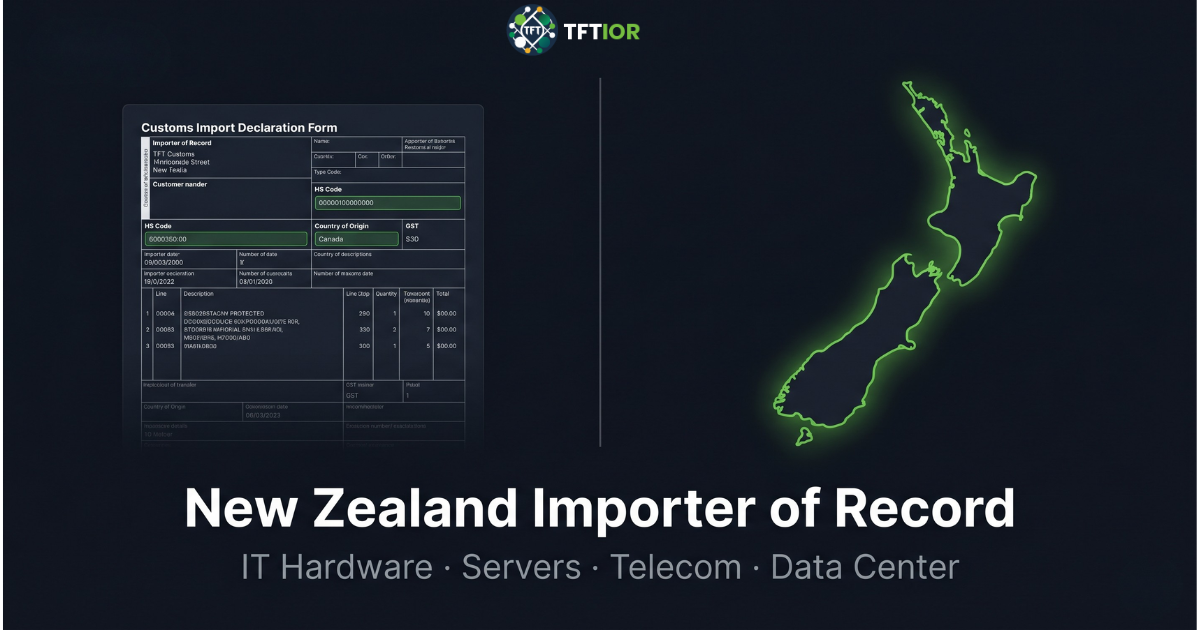
- A customs broker files the JBMS import entry. The Importer of Record is the named legal importer on that entry, holding the client code and relevant New Zealand importer registrations, and carrying liability for classification, GST, duties and post-clearance records. These are different roles and need to be assigned separately before any commercial technology shipment moves.
- MPI biosecurity requirements can apply to used and refurbished IT equipment and to any shipment using wooden packaging without ISPM 15 phytosanitary treatment markings. Equipment previously installed in industrial, field or outdoor environments warrants closer pre-shipment review.
- RSM under the Radiocommunications Act 1989 regulates radio transmitting equipment. Enterprise Wi-Fi access points, cellular gateways, routers with embedded wireless modules, IoT devices and telecom hardware may require RSM compliance review before they can be imported and used in New Zealand. Some device categories are prohibited.
- Refurbished IT hardware is importable but requires more precise documentation than new goods. Imprecise invoice descriptions, inconsistent serial tracking and non-compliant packaging are where refurbished shipments typically run into problems at the border.
- Temporary import entries apply to demo units, evaluation hardware, loan equipment and repair return scenarios. Confirming the correct entry type before dispatch avoids GST exposure on goods that are not permanently entering the New Zealand market.
- A paper IOR arrangement, where a provider appears nominally as the importer without actually holding the required registrations, creates real liability risk that typically only becomes visible when a shipment is questioned. For high-value IT hardware, this is not a theoretical concern.
IOR vs Customs Broker: Why This Distinction Matters for IT Hardware
The most common structural gap in New Zealand technology imports is the confusion between customs broker services and Importer of Record services. Both roles appear in the import process. They are not interchangeable.
- Prepares and lodges the JBMS import entry
- Acts as agent for the named importer
- Uses or references the importer's customs registration details when filing as agent, unless separately appointed under a legally valid importer structure
- Does not automatically accept customs, GST or classification liability
- Is not the legal importer on the entry
- Named legal importer on the JBMS entry
- Holds or controls the importer registrations required for the JBMS entry
- Accepts liability for HS classification, declared value, GST and duties
- Responds to New Zealand Customs Service if the entry is queried
- Retains post-clearance documentation
For foreign companies shipping high-value servers, network infrastructure or telecom equipment, the question is not only "who will file the entry?" It is: whose legal identity and importer registrations sit behind the import declaration, and who carries the consequences if there is a classification dispute, a valuation question or an agency referral? That position is the IOR, and it needs to be assigned and documented before pickup.
See also: IOR vs Customs Broker and Freight Forwarder vs Importer of Record.
IT Hardware Scenarios That Require a Structured IOR in New Zealand
Foreign companies that sell or deploy technology into New Zealand without a local subsidiary, a buyer entity capable of acting as importer, or a distributor formally accepting import responsibility will need a structured IOR arrangement for commercial shipments above NZD 1,000. In practice, almost all commercial IT hardware shipments exceed this threshold.
In each case, the IOR must be confirmed before the shipment moves. For the full service overview and registration details including JBMS filing, NZBN and GST settlement, see the New Zealand IOR service page.
MPI Biosecurity: What IT Hardware Teams Miss
MPI Biosecurity
Technology companies routinely assume that MPI biosecurity applies to food, agricultural products and natural materials, and has no practical relevance for IT hardware imports. This assumption causes avoidable border delays.
MPI enforces biosecurity requirements under the Biosecurity Act 1993 against applicable Import Health Standards. The requirement covers all goods entering New Zealand, and the practical exposure points for IT and data center shipments are:
- Wooden packaging without ISPM 15 markings. Crates, pallets and wooden packing materials without valid phytosanitary treatment markings are a consistent and well-documented MPI referral trigger. This is one of the most preventable causes of clearance delays for technology shipments. ISPM 15 compliance needs to be confirmed at the origin packing stage, not at the New Zealand border.
- Refurbished and used equipment. Equipment previously installed in industrial, manufacturing, field, marine, mining or outdoor environments may carry soil, biological material or contamination that triggers biosecurity inspection. The condition of the equipment matters, not just its product category.
- Mixed cargo. Shipments where non-IT items are packed alongside IT hardware can create biosecurity questions that apply to the entire consignment, not just the non-IT portion.
- Transit residue. Equipment that has passed through high-risk biosecurity zones or has been stored in non-sterile environments may be subject to closer inspection regardless of product type.
MPI also notes that meeting biosecurity requirements does not automatically satisfy other border agencies. A shipment can clear MPI and still be referred to RSM or Customs for separate reasons. Pre-shipment review should account for all applicable border agencies, not just one.
RSM Compliance for IT Hardware with Wireless Functionality
Radio Spectrum Management
RSM (Radio Spectrum Management), operating under MBIE under the Radiocommunications Act 1989, regulates the import and supply of radio transmitting equipment in New Zealand. RSM states that suppliers may need a licence to import and supply radio transmitting equipment. Some electrical and radio products are prohibited, and importing, supplying or using prohibited devices can result in confiscation or prosecution.
For IT hardware imports, the most relevant equipment categories are:
- Enterprise Wi-Fi access points and wireless LAN controllers
- Routers, SD-WAN appliances and network switches with embedded wireless modules
- Cellular and private LTE gateways
- 5G infrastructure and small cell hardware
- IoT modules and edge devices with radio connectivity
- Satellite communication equipment and VSAT terminals
- Bluetooth-enabled monitoring and management hardware
- RFID readers and RF test equipment
- Telecom testing and network measurement equipment
The question to ask before shipping any device with wireless or radio functionality is whether it can legally be imported, supplied and used in New Zealand under the Radiocommunications Act 1989. That review happens before the goods are committed to transport. Identifying an RSM issue after cargo is in a New Zealand warehouse or at port is substantially more disruptive and expensive than catching it before shipment.
Refurbished IT Hardware: Where the Documentation Actually Matters
Refurbished IT equipment is importable into New Zealand. The common problems are not regulatory prohibitions. They are documentation gaps that create avoidable customs or biosecurity questions at the border.
Three patterns cause most of the trouble with refurbished IT imports:
Imprecise invoice descriptions. "Computer parts," "used electronics" or "IT equipment" on a commercial invoice creates questions that precise product descriptions do not. For refurbished servers or networking hardware, the invoice should specify model, condition, serial numbers, condition basis (refurbished, repaired, used, warranty replacement) and the purpose of the import. Ambiguity invites inspection.
Non-ISPM 15 wooden packaging. Refurbished equipment commonly ships in wooden crates from warehouses or decommissioned data centers. If those crates do not carry valid ISPM 15 phytosanitary treatment markings, the shipment goes to MPI for biosecurity review. This adds time and cost that is entirely avoidable.
Condition inconsistency. Equipment described as "refurbished" on the invoice but showing visible contamination, field installation residue or incomplete cleaning may raise biosecurity concerns beyond packaging. Equipment condition should be assessed before packing, not after.
The fix is documentation and preparation at the origin stage, not at the New Zealand border. See: Refurbished IT Equipment Import Guide.
Temporary Imports, RMA and Warranty Replacement Scenarios
Not every IT hardware shipment into New Zealand is a permanent sale. Several common scenarios require a different entry treatment than a standard commercial import, and the entry type needs to be confirmed before the goods move.
Temporary imports. New Zealand Customs provides for temporary import entries where goods will remain in New Zealand for one year or less before being exported. This applies to demo units, evaluation hardware, equipment on loan for a fixed project period, and test equipment sent for a specific engagement. Using a standard import entry for goods that should be under temporary import treatment creates GST exposure that does not apply to the actual transaction.
RMA and repair returns. Return merchandise authorisation shipments and goods sent for repair and return have specific valuation and classification considerations. The entry should reflect the actual basis for the shipment, not a generic invoice value for the equipment. Warranty replacement units sent in exchange for failed equipment also require careful treatment to avoid double-taxation scenarios.
Project-based imports. Foreign companies deploying hardware at a New Zealand customer site under a fixed-term project structure may have a mixture of permanently placed and temporarily deployed equipment within the same shipment. These need to be clearly separated in the documentation before customs filing.
In all of these scenarios, the IOR structure and entry type should be confirmed during pre-shipment planning. For context on the broader non-resident importer model, see: Non-Resident Importer of Record.
Paper IOR Risk for Technology Shipments
A paper IOR arrangement exists when a provider nominally appears as the Importer of Record on shipping documentation but does not actually control or provide the importer registration structure needed to stand behind the JBMS import entry. In practice, the entry is filed under another party's arrangements and the compliance liability remains with the foreign seller.
For low-value, low-risk shipments this may pass without incident. For high-value IT hardware, telecom equipment or regulated goods, the exposure is real. If Customs queries the entry, the party that actually holds the registration is responsible for the response. If GST or duty is assessed incorrectly, the real registrant carries the correction. The foreign seller who thought the IOR position was covered may find that it was not.
Before appointing any IOR provider for a New Zealand technology shipment, confirm that the provider controls the importer registration structure that will be used on the actual JBMS entry, and that the arrangement is documented in writing. See: What Is a Paper IOR? and IOR Liability and Risk Explained.
TFTIOR New Zealand IT Hardware IOR Model
TFTIOR's New Zealand IOR and EOR workflow for technology shipments begins before the goods move. The process is designed for foreign OEMs, cloud infrastructure teams, IT lifecycle companies, freight forwarders and global deployment teams that need a defined importer position with compliance coverage, not just a name on a document.
Equipment Categories Covered
TFTIOR can review New Zealand IOR feasibility for servers and server clusters, GPU and AI inference hardware, storage systems, network switches, routers, firewalls and SD-WAN appliances, data center spare parts and field replaceable units, telecom and wireless hardware, UPS and power distribution equipment, test and monitoring equipment, refurbished IT hardware, warranty replacement units, demo and evaluation units, and RMA and repair return shipments. Acceptance depends on product type, equipment condition, regulatory exposure and documentation completeness at the time of review.
Pricing Factors
IOR coordination costs for New Zealand IT hardware vary by shipment value, product category, equipment condition, wireless or telecom exposure, documentation complexity, entry type and delivery model. Shipments involving RSM review, refurbished goods or temporary import treatment typically involve additional pre-shipment work that affects overall project cost. TFTIOR provides project-specific cost assessment during the feasibility review stage, after shipment details are confirmed.
Common Failure Points in New Zealand IT Hardware Imports
No IOR assigned before shipment. The seller assumes the buyer will import. The buyer assumes the seller will deliver DDP. The freight forwarder assumes someone has a client code. The cargo arrives and nobody has formally accepted the importer position. Clearance stalls while the parties work out who is responsible. The IOR needs to be confirmed before the shipment is booked.
Treating the customs broker as the Importer of Record. A broker can file on behalf of a named importer, but that is not the same as the broker holding the legal importer position. For IT hardware with high declared values or regulatory exposure, the distinction needs to be explicit. See: IOR vs Customs Broker.
Wireless equipment shipped without RSM review. Enterprise Wi-Fi, cellular gateways, routers with embedded wireless modules and telecom devices may need RSM compliance review before they can be imported and used in New Zealand. This is not a paperwork step that can be resolved after the goods arrive. RSM review needs to happen before shipment.
Non-ISPM 15 wooden packaging. Wooden crates, pallets or bracing without valid ISPM 15 phytosanitary treatment markings is one of the most consistent and preventable causes of MPI biosecurity referrals. The fix is at the origin packing stage. By the time the goods are in New Zealand, the referral is already in motion.
Refurbished goods with generic invoice descriptions. "IT parts," "used electronics" or "network equipment" on an invoice for a lot of refurbished servers or switches invites questions that a proper description would have prevented. Condition, model, serial numbers and purpose should appear on the commercial invoice. Vague descriptions do not survive customs or MPI scrutiny particularly well.
Demo or loan equipment filed as a standard import. Equipment that should be under a temporary import entry is sometimes filed as a standard commercial import because the correct entry type was not confirmed before dispatch. This creates GST liability on goods that were never intended to remain in New Zealand permanently. The entry type decision needs to happen at the planning stage.
DDP commitments without a legal import structure. A foreign seller that has committed to DDP delivery without a legal importer structure in New Zealand cannot execute that commitment. When the shipment arrives, the gap between the commercial commitment and the actual capability creates delays and disputes. See: IOR Liability and Risk Explained.
Pre-Quote Checklist for New Zealand IT Hardware IOR
Having the following information ready before requesting a New Zealand IT hardware IOR quote reduces back-and-forth and speeds up feasibility assessment:
| Item | What to provide |
|---|---|
| Product description | Model, manufacturer, function, specification. Not just category name. |
| HS code | If known. If not, product datasheet is the next best input for classification review. |
| Invoice value | Total CIF or FOB value and per-unit breakdown where applicable. |
| Packing list | Including packaging type and material. Flag any wooden crates or pallets. |
| Country of origin | Manufacturing origin, not shipping origin. |
| Equipment condition | New, refurbished, used, repaired, warranty replacement. |
| Wireless or radio functionality | Whether any device in the shipment transmits radio signals of any kind, including Wi-Fi, Bluetooth, cellular or RFID. |
| Incoterms | DAP, DDP, EXW or other agreed terms. DDP requires confirmed IOR structure. |
| Final delivery address | Data center, server room, warehouse, office or project site. |
| Shipment type | Sale, demo, warranty replacement, RMA, repair return, temporary deployment or internal project. |
| Serial numbers | If applicable, or whether asset-level tracking is needed for post-clearance records. |
| Timeline | Site access windows, deployment dates or SLA constraints that affect clearance timing. |
Frequently Asked Questions
What is the difference between an Importer of Record and a customs broker in New Zealand?
A customs broker prepares and lodges the JBMS import entry on behalf of an importer. The Importer of Record is the named legal importer on that entry, whose client code and relevant New Zealand importer registration details are used for the import entry, and who accepts liability for HS classification, valuation, GST, duties and post-clearance records. A broker can act as agent but does not automatically assume legal importer responsibility. For IT hardware, this distinction needs to be documented before shipment.
What happens if wireless or telecom equipment arrives in New Zealand without RSM review?
RSM under the Radiocommunications Act 1989 regulates radio transmitting equipment in New Zealand. Equipment that does not meet RSM requirements may be subject to detention or barred from use. Some categories are prohibited outright. RSM compliance should be confirmed before the goods are shipped, not after they have arrived at a New Zealand port or airport.
How does refurbished IT hardware affect the New Zealand import process?
Refurbished IT hardware is subject to the same JBMS entry requirements as new goods but requires more careful documentation. Imprecise invoice descriptions, non-ISPM 15 wooden packaging and equipment previously used in industrial or outdoor environments can trigger MPI biosecurity referrals or customs queries. Invoice descriptions should reflect actual condition, serial numbers should be documented, and packaging should meet biosecurity standards before the goods leave origin.
What is a paper IOR and why does it matter for IT hardware shipments into New Zealand?
A paper IOR exists when a provider nominally appears as the Importer of Record on documentation but does not actually control or provide the importer registration structure required for the JBMS entry. The compliance burden remains with the foreign seller. For IT hardware with high declared values or regulatory exposure, this creates real liability risk that typically only becomes visible when a shipment is questioned.
Which IT hardware scenarios qualify for temporary import entry in New Zealand?
Temporary import entries apply when goods will remain in New Zealand for one year or less before being exported. Relevant scenarios include demonstration units, evaluation hardware, loan equipment for a fixed project period, and test and repair scenarios where goods return to origin. The entry type needs to be confirmed before dispatch to avoid GST exposure on goods not permanently entering the New Zealand market.
Does MPI biosecurity apply to IT servers and networking equipment?
MPI biosecurity requirements can apply to machinery, used or refurbished equipment and packaging regardless of product category. IT hardware is not automatically exempt. Wooden crates or pallets without ISPM 15 phytosanitary treatment markings are a consistent referral trigger. Refurbished equipment previously used in industrial or field environments may also attract inspection based on condition.
Can TFTIOR handle warranty replacement and RMA shipments into New Zealand?
Yes. Warranty replacement and RMA shipments have specific entry considerations including condition declaration, valuation basis and whether GST recovery or duty relief applies. These scenarios require the entry type and supporting documentation to be defined before the goods move. TFTIOR reviews RMA and warranty replacement shipments as part of the pre-shipment feasibility process.
What information does TFTIOR need to assess New Zealand IT hardware IOR feasibility?
Product description including model and function, HS code if known, commercial invoice value, packing list with packaging material details, country of origin, equipment condition, whether any device transmits radio signals, incoterms, final delivery address, end-user details and shipment type. A complete pre-shipment package reduces the time needed to confirm feasibility and cost.
Shipping IT Hardware into New Zealand?
Send us the product description, invoice value, equipment condition, wireless functionality details and expected delivery timeline. TFTIOR will review importer responsibility, entry type, MPI and RSM exposure, and whether a structured IOR arrangement is needed for your shipment.
We assess every shipment before committing to it. If we cannot support it compliantly, we say so before your cargo moves. MERSIS No. 0859123223400001. SSHYB No. 84634.
Related Resources
TFTIOR (Transparent DIS TICARET LTD.STI.) is a globally operating Importer of Record and Exporter of Record provider with verified IOR and EOR coverage across 40 to 60 active jurisdictions, subject to product and country feasibility review. MERSIS No. 0859123223400001. SSHYB No. 84634 (Ministry of Trade After-Sales Service Authorization). TS 12498 after-sales service qualification for computers and peripherals. ISO 9001, 14001, 45001 certified under IAS, an accreditation body participating in international multilateral recognition frameworks including IAF MLA for management systems. UK operations line: +44 330 533 0223. Updated May 2026.