
IOR Due Diligence · Coverage Verification · Pre-Shipment
Real IOR Coverage vs Logistics Coverage
A country appearing on a coverage map does not mean an Importer of Record can legally and accountably handle a shipment there. This page explains the difference between logistics reach and confirmed importer responsibility, and why that distinction matters before regulated technology cargo moves.

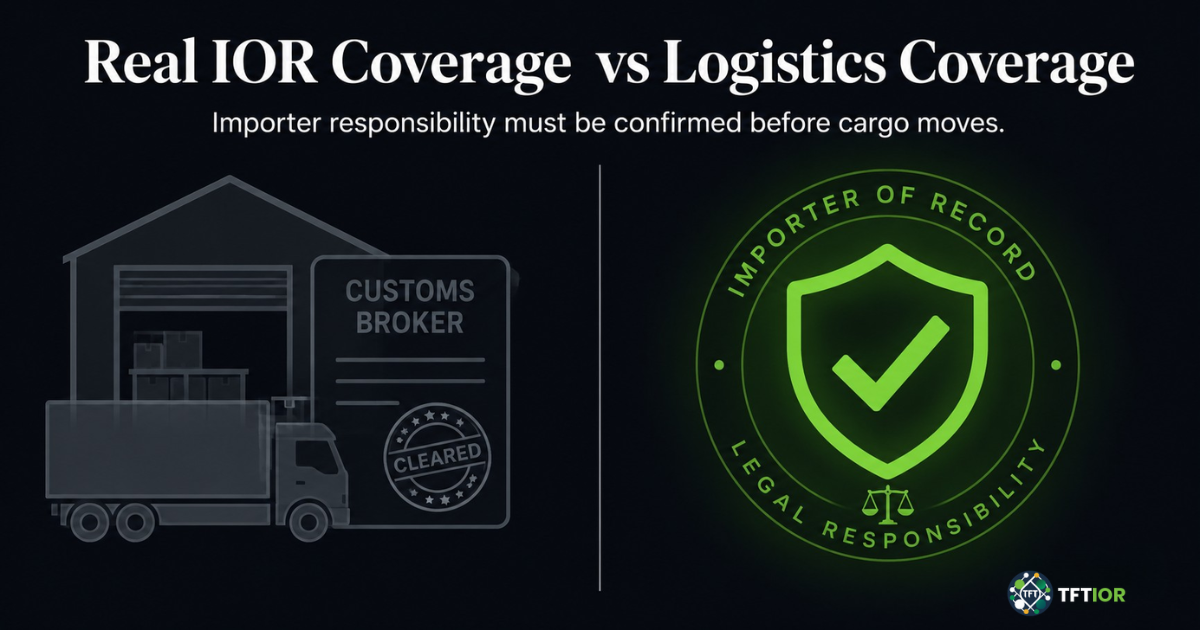
- IOR coverage is a liability commitment, not a geography claim. A provider can arrange freight, appoint a broker, or hold a warehouse in a country without being able to legally act as the Importer of Record there.
- Logistics coverage and importer coverage are different things. Freight reach, broker access, warehouse presence, and local partner contacts each support the import process but none of them alone creates a valid importer structure.
- The central question is not whether a provider can attempt a shipment. It is who accepts importer responsibility for this specific shipment, product category, value, and regulatory profile before cargo moves.
- Failed imports are rarely just customs events. They typically result from importer feasibility never being properly confirmed before dispatch. The failure is visible at the border; the cause occurred much earlier.
- A provider willing to refuse, pause, or restructure a shipment before dispatch is demonstrating a controlled IOR model. A provider that accepts everything without pre-shipment review is passing risk to the buyer.
TFTIOR provides Importer of Record services for regulated technology, IT, telecom, data center and high-value equipment shipments where companies need more than freight movement, broker filing or local delivery coordination.
In international deployments, many providers describe their capabilities using broad country coverage claims. A country may appear on a coverage list because a provider has a freight agent, a customs broker relationship, a warehouse partner, or a delivery route there. None of these alone proves the provider can legally and responsibly act as the Importer of Record for a specific shipment.
"Importing is not a logistics task. It is a liability decision."
Coverage becomes real only when importer responsibility is confirmed for the specific shipment before cargo moves. For regulated technology shipments, servers, networking equipment, telecom hardware, wireless devices, data center infrastructure, refurbished IT equipment, and controlled goods may each involve customs, tax, product compliance, valuation, licensing, conformity, labelling, and post-clearance audit exposure. A warehouse can be outsourced. Importer responsibility cannot be vague.
Why Logistics Reach Gets Mistaken for IOR Coverage
International logistics networks are built on partners. Freight forwarding, warehousing, staging, customs brokerage, trucking, and last-mile delivery are usually performed through specialized partners in each country. That is normal. The problem starts when logistics reach gets presented as Importer of Record coverage.
A provider may be able to arrange transport into a country, know a local broker, access a warehouse, and use a delivery partner. Those capabilities may support an import process, but they do not automatically create a valid importer structure. A shipment may be logistically reachable but not safely importable under a confirmed IOR model. The cargo can physically arrive at the destination airport or seaport while the importer role remains unclear, unsuitable, or legally exposed. This is where many failed imports actually begin.
Freight Coverage, Broker Coverage, and Real IOR Coverage Are Different
Not every operational capability is an Importer of Record capability. The table below shows what each type of coverage typically means, and what it does not prove:
| Coverage Type | What It Usually Means | What It Does Not Prove |
|---|---|---|
| Freight coverage | Cargo can be transported to or from the country | A valid importer has accepted liability |
| Broker coverage | A customs broker can prepare or file declarations | The broker is responsible as the importer |
| Warehouse coverage | Goods can be stored, staged or inspected locally | Importer responsibility has been assigned |
| Delivery coverage | Final-mile movement can be arranged | Customs, tax and regulatory exposure are controlled |
| Partner coverage | A local contact or agent exists | The shipment has confirmed IOR feasibility |
| Real IOR coverage | Importer responsibility is assigned before dispatch | The provider is not merely attempting clearance |
A customs broker may file a declaration, but the broker is not automatically the Importer of Record. A forwarder may coordinate transport, but transport coordination does not equal importer liability. A warehouse may hold the goods, but storage does not resolve customs, tax or regulatory responsibility. Real IOR coverage starts when the importer-side liability is clear. For a deeper explanation of these distinctions, see IOR vs Customs Broker and Freight Forwarder vs Importer of Record.
Real IOR Coverage Means Real Importer Liability
The central question is not whether a provider can "try" a shipment in a country. It is: who accepts importer responsibility for this specific shipment, product category, value, consignee structure, and regulatory profile?
That question cannot be answered by a country list. A country may be reachable by freight, serviceable by a broker, and deliverable by a logistics partner while still not being safely importable under a confirmed IOR structure. Real coverage should be assessed through importer liability, including:
- customs declaration responsibility
- duty and tax exposure
- HS classification review
- customs valuation risk
- product scope and regulatory screening
- importer eligibility
- documentation and recordkeeping
- post-clearance audit exposure
- rejection, return or hold scenarios
- responsibility for importer-side explanations if authorities question the shipment
If importer liability is vague, coverage is vague. For a full breakdown of these obligations, see IOR Liability and Risk Explained.
Entity Presence Is Not Shipment-Specific IOR Capability
A local entity can be useful. In some countries it may be essential. But a local company, address, or registration does not automatically prove real IOR coverage for every shipment type. A local entity may exist yet still be unsuitable for a specific import because:
- the entity does not normally import that product category
- the shipment falls outside its regulatory scope
- telecom, wireless, medical, refurbished or controlled-goods requirements apply
- product documentation is incomplete
- the importer does not want to assume post-clearance liability
- the entity can act only as consignee, not as a true liability-bearing importer
- tax, licensing or registration exposure has not been evaluated
- the entity is part of an informal or nominee-style arrangement
The right question is not "do you have an entity there?" It is: "can importer responsibility be confirmed for this exact shipment before dispatch?" For a broader look at how entity setup compares to IOR as a market entry model, see IOR vs Local Entity Setup.
Country Lists Do Not Prove Importer Responsibility
Broad country coverage claims create false confidence. A provider may list a country as covered because it has delivered cargo there, knows a broker there, has a partner there, or believes a local route may be possible. None of this means the provider has confirmed IOR capability for a regulated technology shipment.
There is a meaningful gap between:
- "we can quote freight"
- "we have a local agent"
- "we can ask our partner"
- "we can attempt clearance"
- "we have handled something similar"
and: "we can accept Importer of Record responsibility for this shipment."
For enterprise buyers, that gap affects cost, timeline, compliance exposure, and operational continuity. A shipment rejected after arrival can trigger return freight, storage charges, re-export procedures, demurrage, rework, replacement shipment planning, deployment delays, and internal escalation. The cheapest provider at quotation stage can become the most expensive option after the shipment fails. This dynamic is explained in detail on the Paper IOR page.
Treating Feasibility as Confirmed Coverage
One of the most common IOR procurement mistakes is treating feasibility as confirmed coverage. A provider may say "we can check," "our partner is reviewing," or "Mexico is covered." These statements may sound reassuring, but they are not the same as confirmed IOR responsibility.
For regulated cargo, a shipment should not move based on assumed feasibility. The importer structure, product file, documentation, customs value, HS classification, and applicable regulatory exposure should be reviewed before dispatch. When that does not happen, the buyer discovers the weakness after the cargo arrives. At that point the provider may explain the failure as a label issue, document issue, customs request, or broker delay. Sometimes those explanations are partly accurate. But in many cases the deeper issue is that importer feasibility was never properly confirmed before the cargo moved.
A failed import is rarely just a customs event. It is usually the result of an unverified importer structure before dispatch. See: Pre-Shipment Compliance Review for IOR.
When Failed Imports Get Blamed on Labels and Documents
In weakly controlled IOR models, the provider may still earn from freight handling, return movement, storage, re-export coordination, or repeated attempts even when the import itself fails. This creates a misalignment. The buyer pays for the failure while the provider explains it as a label, document, consignee, or customs problem.
For technology shipments, the real failure point typically occurred much earlier: product scope not reviewed, importer eligibility not confirmed, country-specific requirements not checked, documentation accepted without regulatory screening, HS classification exposure ignored, or the shipment dispatched before an accountable IOR structure existed. When a provider only reacts after arrival, the shipment has already entered the expensive part of the failure curve. Real IOR work reduces that risk before cargo moves.
Why This Matters More for Regulated Technology
Regulated technology shipments carry higher importer-side exposure than generic cargo. The product types that most frequently surface these issues include servers and rack systems, networking equipment, switches, routers and firewalls, wireless devices, telecom equipment, GPU and AI infrastructure hardware, data center equipment, refurbished IT equipment, medical technology, security systems, and controlled or dual-use items.
These products may require review of product description, HS code, end use, end user, country of origin, customs value, conformity documents, technical datasheets, labelling requirements, telecom or radio features, refurbished or used equipment status, warranty or RMA status, importer registration or eligibility, and license or permit exposure. A logistics provider may move the shipment. A broker may file the entry. A warehouse may receive the cargo. But if importer responsibility is not clearly assigned, the shipment may still fail. See also: IOR for Servers and Data Center Equipment and GPU and AI Hardware Import Guide.
Real Coverage Is Confirmed Before Cargo Moves
For TFTIOR, real IOR coverage is not improvised after arrival. The correct sequence is:
- Review the product and shipment profile
- Identify the destination-country import exposure
- Confirm whether an IOR structure is available
- Review documentation before dispatch
- Assess customs, tax and regulatory risks
- Clarify importer responsibility
- Proceed only when the shipment structure is controlled
This approach may sometimes slow the first response. It may also lead to a refusal, pause, or re-scope before dispatch. That is intentional. A shipment stopped before dispatch is a controlled commercial inconvenience. A shipment rejected after arrival is a compliance and cost escalation. TFTIOR prefers to refuse, pause, or re-scope a shipment before dispatch rather than treat a failed import as an acceptable operational outcome.
What Real IOR Coverage Should Prove
| Liability Signal | What It Proves |
|---|---|
| Named importer responsibility confirmed before dispatch | The shipment is not being improvised after arrival |
| Customs, tax and post-clearance exposure are assigned | The provider is not only arranging movement or filing |
| Product scope reviewed against country rules | The importer is not blindly accepting unknown regulatory risk |
| Active coverage separated from feasibility review | The provider is not selling "maybe" as "covered" |
| Rejection, return or hold scenarios considered upfront | Failure risk is not pushed back to the buyer after the fact |
| Documentation, valuation and HS classification reviewed before movement | Liability is managed before customs entry, not explained after failure |
| The provider can explain its role clearly | The buyer knows who is responsible if authorities question the import |
This does not mean every shipment can be accepted. In real IOR work, refusal is sometimes the correct compliance outcome. A provider that accepts every country, every product, and every shipment without review may not be offering stronger coverage. It may simply be deferring risk until the cargo arrives.
Outsourcing Logistics Is Normal. Outsourcing Responsibility Into Ambiguity Is Not.
IOR services often depend on local execution partners. Customs brokers, freight forwarders, warehouses, transport companies, and inspection providers can all be part of a legitimate import operation. The issue is not whether partners are used. The issue is whether importer responsibility remains controlled.
A provider can outsource physical logistics functions while still maintaining importer-side governance. What cannot be outsourced into ambiguity is the legal, fiscal, and regulatory responsibility of the Importer of Record. Warehouse handling, trucking, freight movement, brokerage execution, staging, and final-mile delivery can all be coordinated through partners. Importer responsibility must remain clear.
TFTIOR separates active IOR coverage, controlled partner-supported execution, and feasibility-review markets. We do not treat every logistics contact, warehouse partner, broker relationship, or freight route as confirmed Importer of Record capability. Our role is to help companies determine whether a shipment can move under a controlled importer structure before cargo is dispatched. For data center and regulated technology deployments, this distinction is especially important. The buyer does not only need cargo movement. The buyer needs a shipment structure that can survive customs review, regulatory questioning, tax exposure, and post-clearance audit scrutiny.
Practical Warning Signs in IOR Coverage Claims
A provider's coverage claim warrants close examination when:
- The country is listed as covered but importer responsibility is not explained
- The provider only mentions a broker or local agent as the IOR structure
- The quote is issued before product and document review
- The provider says "we can try" but presents this as confirmed coverage
- The importer entity is not clearly identified or qualified
- Regulated product exposure is ignored or not addressed
- Rejection or return scenarios are not discussed at onboarding
- Responsibility shifts to the buyer once the shipment fails
- The provider blames labels, documents or customs only after arrival
- The provider may still charge for return, storage or re-export activity after failure
These signs do not always indicate bad faith. Sometimes they reflect poor process, weak screening, or a logistics-first operating model. For regulated technology shipments, poor process can be enough to create serious cost and compliance exposure. See: What Is a Paper IOR?
The Real Risk Is Unassigned Responsibility
Many buyers focus on transit time and clearance speed. Those matter. But the larger risk is unassigned responsibility. When importer responsibility is unclear, every problem becomes harder to resolve: who responds to customs, who explains the product, who owns valuation risk, who handles tax exposure, who maintains records, who manages post-clearance audit questions, who pays if the shipment must be returned, who decides whether the shipment should have moved at all.
If the provider cannot answer these questions before dispatch, the shipment may not have real IOR coverage. It may only have logistics coverage.
Real IOR Coverage Is a Pre-Shipment Discipline
The most important IOR decisions happen before cargo moves. Once the shipment has departed, the buyer has fewer options. Freight has been paid, timelines have started, project stakeholders are waiting, and destination-side costs may begin accumulating.
Pre-shipment importer validation is the control point. That is where the provider should review whether the shipment can be imported under a valid, accountable structure. It is also where difficult but necessary decisions must be made. Sometimes the right answer is to proceed. Sometimes it is to revise documents, change the importer structure, pause the shipment, separate product lines, obtain additional documentation, re-check regulatory scope, change routing, or decline the shipment entirely.
That discipline is what separates real IOR coverage from reactive logistics troubleshooting. See also: Non-Resident Importer of Record.
Frequently Asked Questions
Is logistics coverage the same as Importer of Record coverage?
No. Logistics coverage means that freight, delivery, warehousing or local handling can be arranged. Importer of Record coverage means a valid importer structure can accept customs, tax, regulatory and post-clearance responsibility for the shipment. A provider can have logistics reach in a market without being able to lawfully and accountably act as the Importer of Record there.
Does having a local entity prove IOR coverage?
Not by itself. A local entity may exist but still be unsuitable for a specific shipment due to product category restrictions, regulatory scope limitations, incomplete documentation, or the entity's unwillingness to assume post-clearance liability. Real IOR coverage must be confirmed for the actual shipment before cargo moves.
Can a customs broker act as the Importer of Record?
A customs broker may support declaration filing, but broker involvement does not automatically make the broker the Importer of Record. Importer-side liability must be clearly assigned to a named entity before the shipment moves. Broker coverage and importer coverage are different things. See: IOR vs Customs Broker.
Why do failed imports often happen after cargo arrives?
Most failed imports happen because importer feasibility, documentation, product scope or regulatory exposure was not properly reviewed before dispatch. Once cargo arrives, the options become expensive: return freight, storage charges, re-export procedures, demurrage, and deployment delays. Pre-shipment validation is the control point that is often missing in logistics-first models.
What does real IOR coverage prove?
Real IOR coverage proves that importer responsibility is confirmed before shipment. This includes customs declaration responsibility, duty and tax exposure, HS classification review, regulatory screening, documentation readiness, and post-clearance audit accountability for the specific shipment in the specific destination market.
Need to Verify Whether Your Destination Requires Real IOR Coverage?
Send the destination country, equipment type, shipment profile, and delivery requirements. TFTIOR will assess whether importer responsibility can be properly confirmed before cargo moves, and what pre-shipment review the shipment requires.
We screen every shipment before accepting it. If we cannot execute it compliantly, we say so before your cargo moves. MERSIS No. 0859123223400001. SSHYB No. 84634.
Related Resources
TFTIOR (Transparent DIS TICARET LTD.STI.) is a globally operating Importer of Record and Exporter of Record provider with verified IOR and EOR coverage across 40 to 60 jurisdictions, subject to product and country feasibility review. MERSIS No. 0859123223400001. SSHYB No. 84634 (Ministry of Trade After-Sales Service Authorization). TS 12498 after-sales service qualification for computers and peripherals. ISO 9001, 14001, 45001 certified under IAS, an accreditation body participating in international multilateral recognition frameworks including IAF MLA for management systems. UK operations line: +44 330 533 0223. Published June 2026.